
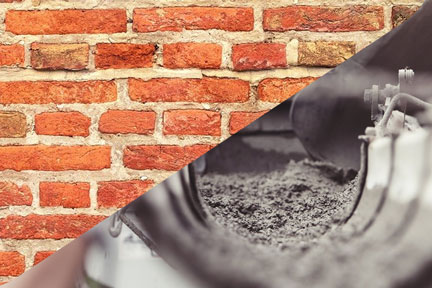
Components in the Brick & Cement/Concrete industries are subject to Corrosion, Wear, and Heat – all of which can affect downtime and productivity. The Metal Spray process or the use of TufCote® provides solutions to these issues.
Brick Manufacturing
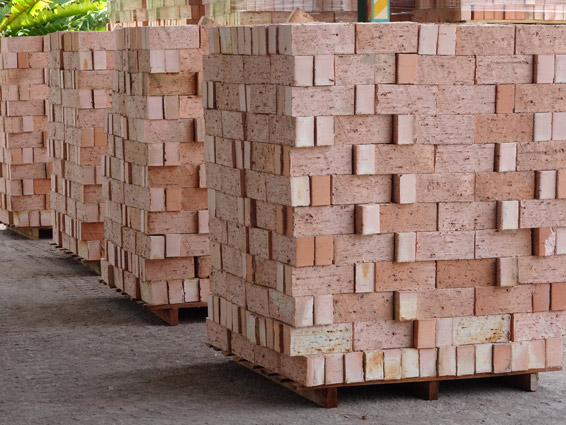
Man has for many years used many different materials for constructing and building dwellings, though none more-so than the brick. In the ancient city of Ur, in Mesopotamia (modern Iraq), the first true arch of sun-baked brick was made about 4000 B.C. The arch itself has not survived, but a description of it includes the first known reference to mortars other than mud. Bitumen slime was used to bind the bricks together.
Essentially, bricks are produced by mixing ground clay with water, forming the clay into the desired shape, and drying and firing.
The brick manufacturing process has six stages:
- Mining and storage of raw materials
- Preparing raw materials
- Forming the brick
- Drying
- Firing and cooling
- De-hacking and storing finished products.
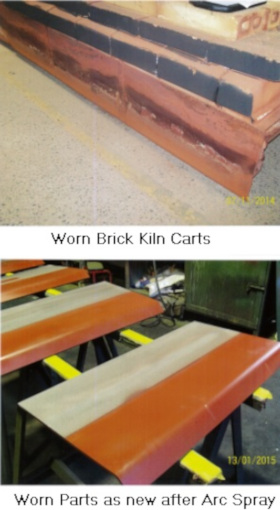 Within these stages components in the manufacturing process become subjected to Corrosion, Wear, and Heat – all of which can affect downtime and productivity.
The Metal Spray process has been around since the early 1900’s and has used its ability to protect surfaces from these types of wear offering protection to OEM parts as well as reclamation.
The image to the right (top) show brick kiln carts as nearing their end of life, typical condition after years of operation, then photos of the new plates after arc spray is applied to the flame affected zone. The Arc Spray provides erosion resistance from the gas burner’s flame application inside the kiln.
In the Arc Spray process, the raw material in the form of two metallic wires are melted by an electric arc. This molten material is then transferred to the substrate by compressed air. The molten metal spray solidifies on the substrate to form a dense, strongly adherent coating.
The process allows for many variations of metal materials to be applied to provide numerous solutions to varying forms of wear. With the metal spray process, Ceramic and Plastic materials can also be applied using associated metal spray equipment.
Other components that are subject to wear include: augers, the edges of screws, pulveriser mill scrappers, cones, combs, crushing hammers, mixer blades etc.
The wear of Core Brick Bridges is minimised and repaired by using an Oxygen Acetylene Hard Facing powder spray torch to apply Tungsten carbide in a 60 HRc Nickel, Chrome Boron matrix.
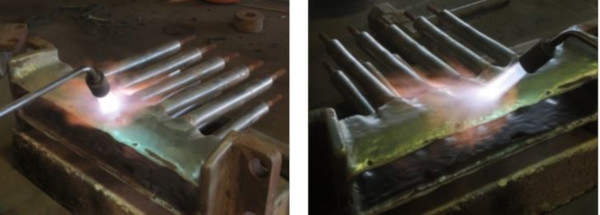
Both Metal Spraying, Hard facing and Brick Manufacturing processes have shown their maturity and ability to develop to meet today’s expectations of increased efficiency with minimised negative effects on the environment.
Clay Extraction and Brick Making
Industry: Brick, clay and tile making.
Problem: Tools are subject to severe abrasion resulting from the minerals contained in the clay (SiO2, Al2O3).
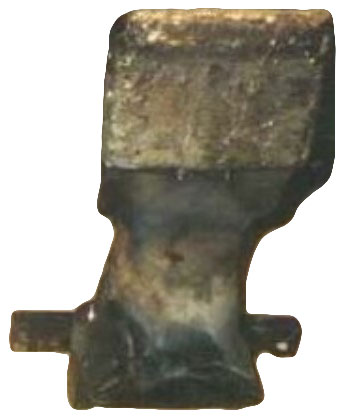
Crushing Hammer
Equipment: The application with TufCote® G-N or G-A 6mm ⌀ (even 8mm) products concerns mainly the extraction to the pressing phases:
- Bucket wheel excavator, teeth of bucket, extraction conveyor.
- Disintegrator crusher knives.
- Extracting screws, screened feeders, screen gratings.
- Shredder knives, puller hooks, pug mill augers.
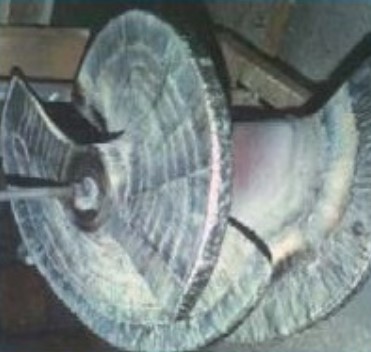
Moulding Screw
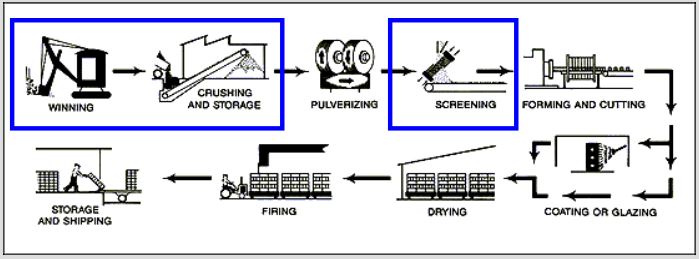
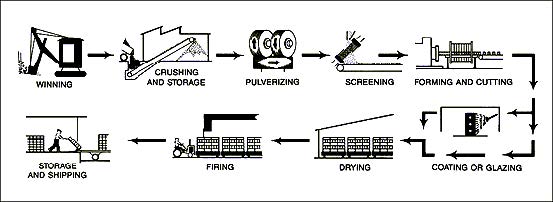
Principle of the Process: Extraction of earth, crushing and storage, pulverisation, screening, forming or pressing, cutting, coating or glazing, drying, firing.
Service Conditions:
- Ambient temperature ~20-50°C.
- Abrasives particles mixed with water.
- Medium shocks possible.
- Clay contains 7-30% water.
Coating Solution: Abrasion Resistant Coatings:
- TufCote® Grade N or A 6mm ⌀ – tungsten carbide with a metal matrix
- 3 to 5 mm thickness are required
Benefits of TufCote®
- TufCote® extends the life time 3 times more than Cr cast iron.
- Simplicity, easy learning of the brazing procedure make it a possible application on site or in job shop.
- No capital investment is required to apply the TufCote®.
brazing flexible cord (only a flame torch is required). - Expensive steels are not required to manufacture the blades.
- Possibility to rebuilt on a coating previously welded.
- Coarse and angular tungsten carbide grains, for better.
resistance to abrasion (TufCote® Grade A).
TufCote® GRADE A Product Specification
- Self fluxing alloy matrix : 32 to 40% in weight.
- Tungsten carbides: 60 to 68% in weight.
- Particle size: Grade N within 0.8 mm or grade A within 1.6 mm.
- Packaging: TufCote® is supplied as a continuous flexible cord, length depending on diameter and included in a protective plastic box. Available diameters are 4.75 or 6.35 or 8mm.
TufCote® Application Procedure
Preparation of the Piece
- Surface must be cleaned and free of surface contamination.
- All edges must be cut by grinding.
Preheating of the Area
- With oxy-acetylene torch, preheat the piece area to 450°C (840°F).
Prime Cote (if required)
When welding stainless steel with TufCote®, an under layer might be applied about 300µm thick on surface before apply TufCote®:
- To avoid any oxidation of surface
- To prevent chromium migration to the surface (black bulk)
- To increase adherence of TufCote®.
Hard-facing Operation with TufCote®
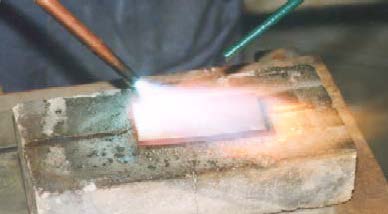
- The torch flame must form an angle of about 45° with the piece surface to be hard-faced, and TufCote® at a 45° angle to the same surface.
- The flame must swing from side to side of the weld deposit.
- TufCote® is then fed through the holder 4-6” at a time.
- The tip of the cord should not be lowered or lifted during the fusion process.
- The maximum speed of deposition is about 2Kg/hour (4.2 lbs/hour).
Concrete Mixer Blades
Industry: Cement concrete production.
Concrete Production: Cement powder, water, resins, sand and crushed stones, are mixed together before to be carried-out by special trucks.
Problem: During mixing, blades are subject to severe abrasion from the concrete, wear reduces thus the thickness of the blades up-to breakage. The concrete production center can not be subject to production stop during mixing because it will cause the further solidification of the concrete.
Service Conditions:
- Ambient temperature ~20°C to 50°C.
- Medium corrosion environment.
- Severe abrasion from the cement.
- Risk of shocks.
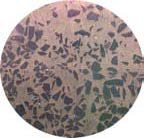
Caution: Usually, the blades of the mixer are manufactured from Chromium cast iron. Due to the low thermal expansion coefficient, the Cr-Cast Iron cannot be directly brazed thanks to the TufCote®. New mixing blades should be manufactured with a construction steel and then brazed with the TufCote®.
Coating Solution: TufCote® Abrasion resistant coating: Tungsten carbide with a metal matrix; 5 mm thickness. Use specifically the TufCote® Grade A 8mm ⌀ (even 6.35mm).
Benefits of the TufCote®:
- TufCote® extends the life time 3 times more than Cr cast iron.
- Simplicity, easy learning of the brazing procedure make it a possible application on site or in job shop.
- No capital investment is required to apply the TufCote® brazing flexible cord (only a flame torch is required).
- Expensive steels are not required to manufacture the blades.
- Possibility to rebuilt on a coating previously welded.
- Coarse and angular tungsten carbide grains, for better resistance to abrasion (TufCote® Grade A).
TufCote® Application Procedure:
Preparation of the Piece
- Surface must be cleaned and free of surface contamination.
- All edges must be cut by grinding.
Preheating of the Area
- With oxy-acetylene torch, preheat the piece area to 450°C (840°F).
Prime Cote (if required)
PRIME COTE under layer might be applied about 300μm thick.
- To avoid oxidation of surface.
- To increase TufCote® bonding.
Hard-facing Operation
- The torch flame must form an angle of about 45° with the piece surface to be hard-faced, and TufCote® at a 45° angle to the same surface.
- The flame must swing from side to side of the weld cladding.
- TufCote® is then fed through the holder 4-6” at a time.
- The tip of the cord should not be lowered or lifted during fusion.
- Speed of cladding is ~2Kg/h.
TufCote® GA Specification:
- Self Fluxing Matrix: 37 to 40%W.
- Tungsten Carbides: 60 to 63%W, Particle Size: Grade A within 0.1 to 1.6mm (10-150 mesh).
- Packaging: Continuous flexible cord coiled on spool. Available diameter 4.75 or 6.35 or 8mm.
Centrifugal Fan Blades
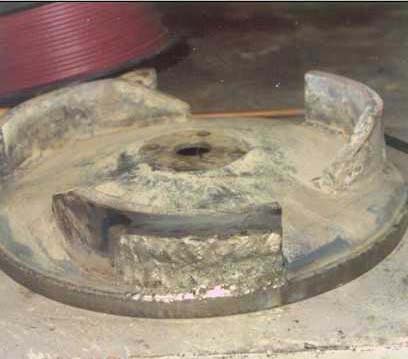
Industry: Cement Production
Cement Production: Cement is a mixture of compounds made by burning limestone and clay together at very high temperatures ranging from 1400 to 1600°C. Then, 5% Gypsum could be added.
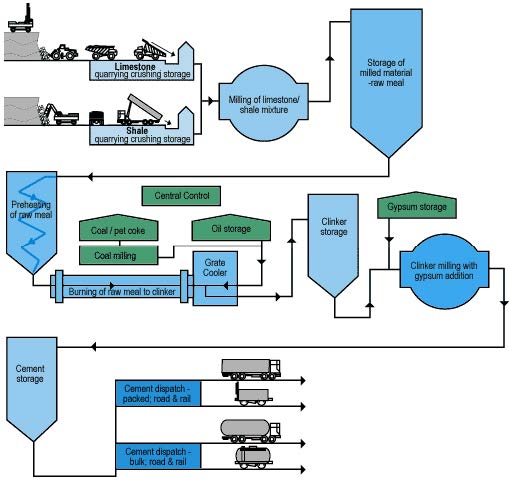
Problem: During mixing procedure and cement powder transportation phases, fans and equipment are subject to severe erosion from the cement powder. Wear reduces thus the thickness of the tools up-to breakage. The cement production plant can not be subject to production stop.
Service Conditions:
- Ambient temperature ~20°C up to 600°C.
- Severe erosion from the cement powder.
Note: TufCote® can be used only when the temperature is lower than 600°C.
Caution: Usually, the blades are manufactured from alloyed iron. Due to the difference of thermal expansion coefficient, the alloyed iron cannot be directly brazed thanks to the TufCote®. New mixing blades should be manufactured with a construction steel and then brazed with the TufCote®.
Coating Solution: TufCote® Abrasion Resistant Coating:
- Tungsten carbide with a metal matrix.
- 2 to 5 mm thickness.
- Use specifically the TufCote® Grade A 8mm ⌀ (even 6.35mm) when temperature is closed to ambient temperature.
- Use TufCote® CO Grade A when temperature is up to 600°C.
Benefits of the TufCote®
- TufCote® extends the life time 3 times more than alloyed iron.
- Simplicity, easy learning of the brazing procedure make it a possible application on site or in job shop.
- No capital investment is required to apply the TufCote® brazing flexible cord (only a flame torch is required).
- Expensive steels are not required to manufacture the blades.
- Possibility to rebuilt on a coating previously welded.
- Coarse and angular tungsten carbide grains, for better resistance to abrasion (TufCote® Grade A).
TufCote® GA Specification
- Self Fluxing Matrix: 37 to 40%W
- Tungsten Carbides: 60 to 63%W
- Particle Size: Grade A within 0.1 to 1.6 mm (10–150 mesh)
- Packaging: Continuous flexible cord coiled on spool. Available diameter 4.75 or 6.35 or 8mm.
Cylindrical Crusher Scrapper Blade
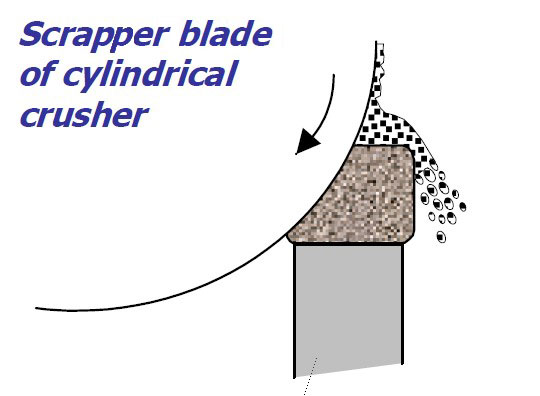
Industry: Brick and Tile Making
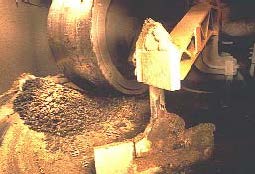
Principle of the Process: Mixing and forming of the clay.
Equipment Concerned:
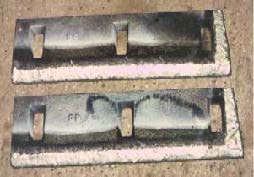
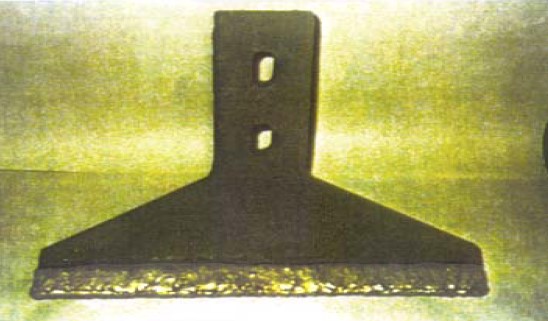
The application with TufCote® Grade A-S (8mm or 6.35mm ⌀) flex-cord concerns mainly the mixing and forming phases:
- Mixer blades, cylinder scrapper blade, mixer screw, mixer knives,
- Thread flank of extrusion screw.
Service Conditions:
- Friction of the scrapper blade against the cylinder.
- Friction of the screw (diameter).
- For better efficiency during pulverising or mixing, the scrapper blade should remain in contact to the casing or cylinder.
- Ambient temperature ~20°C to 50°C.
- Abrasives particles mixed with water.
- Medium shocks resistance.
- Corrosion: Clay contains 7 to 30% water.
Problem:
- The scrapper blade should not scratch the cylinder or casing
- If scrapper blade do not remain in contact to the casing or to the cylinder: machinery efficiency during pulverising or mixing decreases and the quality of the mixed raw material change (bigger particles size, agglomerate…).
- Tools are subject to severe abrasion resulting from the minerals contained in the clay.
Coating Solution: Abrasion resistant coatings TufCote® Grade A-S Diam 6.35 or 8mm or TufCote® Grade M Diam 6.35 or 8mm: tungsten carbide with a metal matrix. 3 to 5 mm thickness are required.
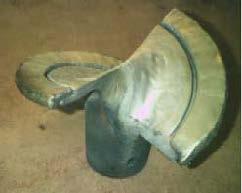
Pug Mil Auger
Benefits of the TufCote® Grade A-S:
- Spherical tungsten carbide grains, do not damage the cylinder or the casing during friction.
- The shape of the scraper blade remain the same.
- Life time is 6 to 7 times more than lifetime with special steels.
- Significant reduction of the machinery power.
- No capital investment is required to apply the TufCote® brazing flexible cord (only a flame torch is required).
- Possible application on site or in job shop.
- TufCote® application procedure is easy to learn,
- TufCote® can be applied on construction steel (the hard steels, or special and expensive steels are not required)
- Possibility to rebuilt on a cladding previously welded.
- The coaxial metal wire inside the cord and avoids “butt” effect.
TufCote® GRADE A-S Product Specification
- Self fluxing alloy matrix: 37 to 40% in weight
- Tungsten carbides: 60 to 63% in weight
- Particle size: Grade A-S within 0.1 to 0.8mm
- Packaging: TufCote® is supplied as a continuous flexible cord, length depending on diameter and included in a protective plastic box. Available diameter 6.35mm or 8mm.
TufCote® Application Procedure:
Preparation of the Piece
- Surface must be cleaned and free of surface contamination.
- All edges must be cut by grinding.
Preheating of the Area
- With oxy-acetylene torch, preheat the piece area to 450°C (840°F).
Prime Cote (if required)
PRIME COTE under layer might be applied about 300μm thick.
- To avoid oxidation of surface.
- To increase TufCote® bonding.
- To prevent chromium migration to the surface (black bulk).
Hard-facing Operation
- The torch flame must form an angle of about 45° with the piece surface to be hard-faced, and TufCote® at a 45° angle to the same surface.
- The flame must swing from side to side of the weld cladding.
- TufCote® is then fed through the holder 4-6” at a time.
- The tip of the cord should not be lowered or lifted during fusion.
- Speed of cladding is ~2Kg/h.
Clay Extraction Plant Plates
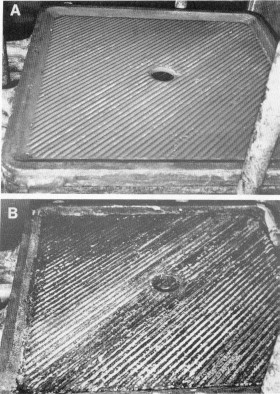
The plates in the above image are part of a filtration plant at the Trelavour Kiln, St Dennis, Cornwall, UK where china clay is extracted and refined from the St. Austell granite. The plates are subject to high temperature sulphur based acids, with the consequent problems of iron corrosion and contamination of the china clay.
The plate in photograph (A) was zinc sprayed to Metallisation Zn4/a. The adjacent plate, in photograph (B), was left untreated. The protection afforded by the treatment is clearly visible and another plate, aluminium sprayed to Metallisation AI4/a was equally successful.
Related Industry Application
For another construction-related application, view our Concrete Restoration page.
For more information on our equipment or consumables, call us on 07 3823 1004, or email us using our contact form.