Heat Source
Gas fuel* and oxygen flame (*commonly propane or acetylene).
Material
Wire or powder (depending on gun).
Transfer
Compressed air (wire flame).
Process
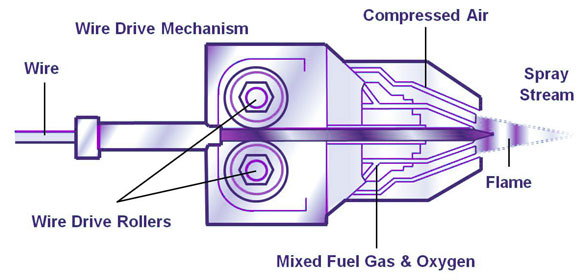
The gas fuel and oxygen are mixed and ignited to produce a flame. The material, either a wire or powder is fed into the flame. For wire flame spray, the material is melted and the compressed air, passing through a spray nozzle atomises the molten metal and sprays it onto the work piece. The larger the wire diameter, the higher the spray rate. As a general principle, the throughput rate of the spray system is linked to the wire diameter, for example, a 1.6mm wire will spray considerably slower than a 4.76mm wire. For powder flame spray, the powder particles (metal or ceramic) are softened in the flame and the speed of the flame gases through the nozzle sprays the softened powder onto the work piece. Flame spray systems are commonly manually operated but it is possible to semi-automate or fully-automate the process if required. Capital costs of flame spraying are typically lower than arc spraying but the running costs are typically higher. The amount of material that can be sprayed by the flame spray process is limited by the size of wire and the material being sprayed.
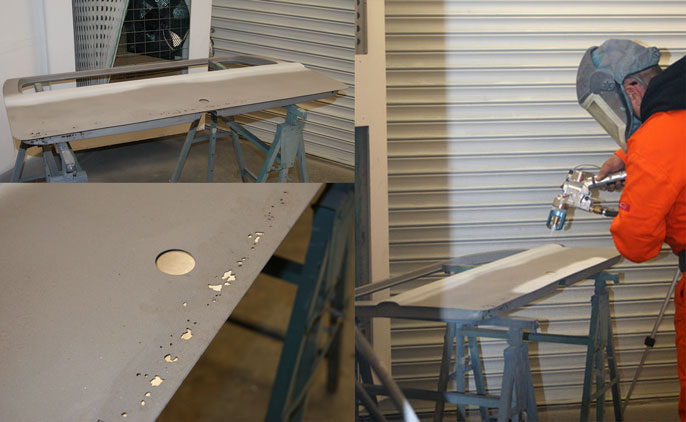
Flame spraying can be seen as a similar concept to paint spraying. Once the system is connected up, the sprayer operates a valve to start the gases flowing and lights the gas stream. A trigger is then used to start/stop the wire/powder feed into the flame and the coating is deposited in a similar way to spray painting. These systems are used to reclaim surfaces by applying a similar material or give the surface different properties by coating it with a different material. Most metals can have an aluminium coating applied by the flame spray process. This can be for aesthetic, anti-corrosion, conductivity or many other reasons. Zinc can also be applied to most substrates using the flame spray process. This is often to provide galvanic protection of the substrate, but may be for a number of other reasons.
With flame spraying, you are using the heat that is generated from the combustion of a mixture of oxygen and a fuel gas, commonly oxy/propane or oxy/acetylene. The molten material is atomised and sprayed to build up a coating layer. Propane gas is most commonly used for spraying low melting point materials such as zinc, aluminium and their alloys at high throughput rates. Propane can also be used to spray bronzes, coppers, Babbitt, nickel, tin/zinc and some steels, although optimum throughput rates may not be achieved with these materials. The Metallisation MK73 system uses propane gas.
Acetylene gas is most commonly used for spraying higher melting point materials such as varying grades of steel, nichrome and molybdenum. When spraying with acetylene, parameters can be easily changed that will give different coating properties. For example, molybdenum coatings can be applied as either a soft, strongly adherent bond coating or as a harder top coating, just by changing the ratio’s of gas to oxygen. Similarly, some decorative coatings of copper and bronzes can have their final colour appearance influenced by the spray parameters. As with propane gas, acetylene gas systems can also spray the lower melting point materials of zinc, aluminium and their alloys, but again, not necessarily at their optimum conditions. The Metallisation MK61 system uses acetylene gas.
General Features
- Engineering applications.
- Anti-corrosion applications.
- Wire flame and powder flame models available.
- Variety of hose lengths to suit each application.
- Spreader and non-spreader versions to allow detail work or larger areas to be sprayed efficiently.
- Stop/start version allows operator to stop spraying and leave the flame lit (e.g., whilst inspecting or moving the work piece).
- Wire sizes 1.6mm to 4.76mm (3/16”) to suit many application and coating requirements (depending on model selection).
- Manual or automatic operation.
- Deflected flame spray extension available.
- Flame/Powder Spray Equipment Trolleys also available.
Application Examples
Please note that some of the applications listed below are relative to particular Flame Spray systems. Contact us if you have any questions.
Typical applications can be broken down into two different categories – anti-corrosion and engineering coatings.
Anti-corrosion coatings are applied to generally protect steelwork from a corrosive atmosphere with the most commonly sprayed materials being zinc, aluminium and their alloys. Common application examples include the spraying of steel bridges, in-situ pipework in petrochemical refineries, street furniture and vehicle chassis’.
Engineering coatings cover a much wider range of applications where the coating could, for example, provide a wear protection surface, a thermal barrier coating or an electrically conductive path. Common applications include spraying steels to build up worn or mis-machined areas on a variety of components, conductive heater elements on carbon fibre wing edges and hard molybdenum coatings on selector forks.
Flame Spray Systems can be used in a range of applications including, but not limited to:
- Anti-corrosion coatings.
- Anti-spark coatings.
- Architectural Forged Iron Ornaments Restoration.
- Architectural metalwork.
- Bearing and seal surfaces.
- Bond coats.
- Bridges.
- Car Body Panel Repair.
- Cast iron fencing restoration.
- Cellulose pressure roll.
- Ceramics for insulation, heat resistance (thermal barrier) etc.
- Clutch Diaphragm Springs Reclamation.
- Corrosion under insulation applications.
- Crucible vessels.
- Cruise ship bearing.
- Engineering coatings.
- Exhaust systems.
- Fences/gates.
- Fine coatings with low heat input.
- Grip coatings.
- Marine applications.
- Mining components.
- Molybdenum.
- Mould manufacturing.
- Non-critical surface restoration.
- Offshore platforms.
- Pipelines.
- Piston Rings.
- Reclaiming parts.
- Reclamation of ball bearing seats on rubber coated print rollers.
- Reclamation of engineering components.
- Reclamation of propeller shafts.
- Reclamation of rudder posts.
- Self fluxing alloys for extreme wear applications.
- Sliding wear applications requiring self-lubricating coatings.
- Spinning machine trough ceramic coating.
- Spray/fused coatings.
- Steel clutch lever reclamation.
- Stud welded fasteners.
- Street furniture.
- Structural steelwork.
- Tanks and vessels.
- Trailer chassis.
- Vintage car chassis restoration.
- Wear coatings.