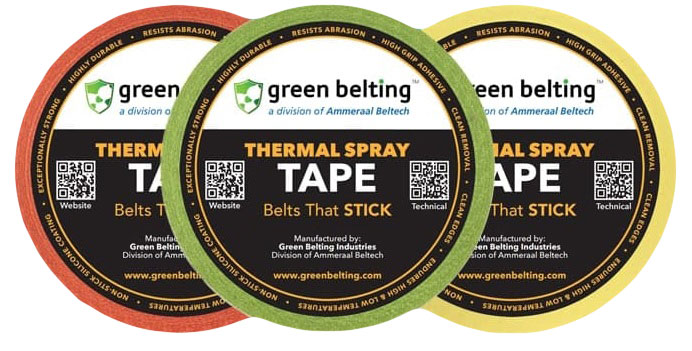
The MSSA masking tape range is manufactured by Green Belting and includes Aluminium Foil, Silicon-Coated Fibreglass, Fiberglass, and Multi-Layer tapes. Each tape is designed to suit the particular Metal Spray process being used.
Use of masking products during the Metal Spray process enables the operator the ability to coat particular sections of a component without the possibility of overspray onto areas outside of the designated spray area. This is especially helpful with intricate spray jobs that either require thicker coatings in particular areas and/or where only particular areas are to be coated.

When masking high-value parts in preparation for the intense forces of thermal spray coating, you want to be sure that you are using materials that are designed and proven to stand up to the test. Finding out later that the tape surface was compromised, or the adhesive didn’t hold will only leave you with costly and time consuming repair, or worse, scrap. As a proven and trusted leader in the innovation and production of high-quality thermal spray masking materials, Green Belting Industries provides masking materials that are engineered, tested*, and proven in spray shops around the world. We are committed to helping you find the best masking product for your application.
Arc Spray Tapes

The primary challenge associated with the Arc Spray coating process is the wide spray plume that exits the gun. This results in the necessity of primary masking, close to the target zone, and secondary masking to protect large non-target areas from overspray and costly clean-up or re-work. While arc spray is not as abrasive as other spray processes, it still requires proper masking to ensure protection of the part and non-target surfaces.
Using the correct selection of Green Belting masking products, operators can develop a masking strategy to overcome the following key considerations:
- Abrasion Resistance – Recommended Green Belting tapes will resist high abrasion, this allows the masking material to maintain its integrity. Most of the abrasion can and will come from the grit blast process. The material is applied once and will survive both grit blast and arc spray.
- Strong Adhesion of Tapes – Adhesion to metal is a necessity for a Metal Spray masking tape. Green Belting’s 170 series tapes exhibit very strong adhesion to metal and “face to back”. The benefit of the strong adhesion is a masking tape that will stay firmly in place with no lifting or flagging.
- Resistance to Heat Transfer – While the heat associated with arc spray coatings is not as intense as high energy styles of thermal spray, resistance to burning is still important. The Green Belting tapes will not be affected by the heat. This heat resistance is key to maintaining clean coating lines with no distortion along the masking edges.
- Highly Conformable – All of Green Belting masking products are designed to conform to complex profiles quickly and easily. This conformability is important to achieve accurate and reliable masking.
- Clean Release – Green Belting tapes leave no residue on removal after blasting and spraying. Adhesive residue can be a major problem for some competing thermal spray masking tapes. Green Belting masking products leave no adhesive residue which results in no need for any extra clean up and/or rework.
Recommended materials: 170-10S YL & 20S YL, 170-10S Green, 179-20S or 25S.
Flame Spray Tapes
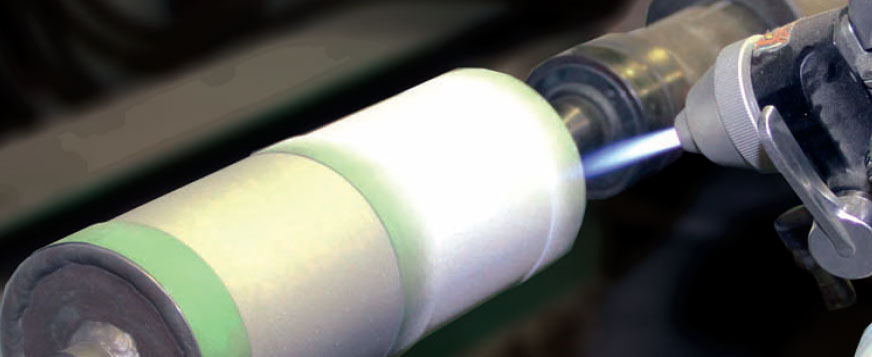
Flame Spray coatings, (combustion coatings) are a very basic form of thermal spray coating. Because of the relatively low heat and abrasion, coatings are often applied with hand-held spray guns in an open shop setting rather than within a spray booth. Many Green Belting Industries masking materials are well-suited from this process. Masking strategies should contemplate materials that are capable of withstanding both the grit blast and flame spray coating process in order to save time and reduce cost.
Green Belting masking tapes are engineered to meet the demands of a wide range of thermal spray coating processes, including flame spray. They offer superior performance due to the following attributes:
- Abrasion Resistance – The types of coatings and thicknesses used are engineered to resist the abrasive forces of both the grit blast and flame spray coating processes. Green Belting tapes can be applied once for both grit blasting and flame spray coatings.
- Strong Adhesion of Tapes – Masking tapes exhibit high adhesion to metal and to themselves (to prevent flagging).
- Resistance to Heat Transfer – From the substrate to the coatings and adhesives, Green Belting masking materials are engineered to resist the extreme temperatures of thermal spray coating processes including flame spray.
- Highly Conformable – Green Belting tapes are easy to work with and conform well to surface contours in more complex masking applications.
- Clean Release – Despite high adhesion, the tapes are designed to remove cleanly with no adhesive residue.

Recommended materials: 170-10S YL & 20S YL, 170-10S Green, 170-10S Red, 179-20S or 25S.
Grit Blast Tapes
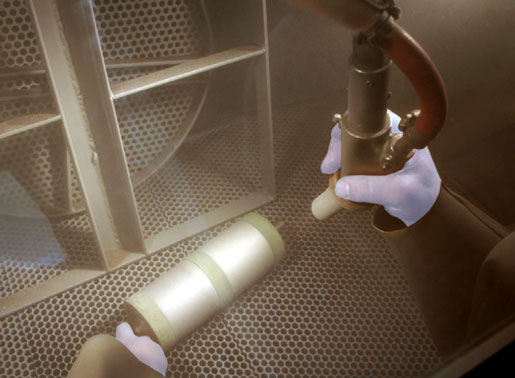
Grit Blasting is a surface preparation process in which a high-pressure stream of abrasive material is directed at the surface of a part of component to create shape, add surface texture (rough or smooth), or to remove surface coatings or contaiminants. The grit blast process is used in thermal spray facilities. The type of grit media used depends on the application and the type of substrate. To effectively prepare the component for the thermal spray coating, sharp, angular media, such as aluminium oxide, is blasted at high pressure towards a target surface to remove unwanted coatings and to apply a desired (roughened) surface texture. Green Belting Industries masking materials, such as 170-10S Green are well suited to endure both the grit blast and spray coating processes, thus saving significant time and cost.
Most thermal spray facilities use abrasive blasting to etch and prepare surfaces to snure good bonding surfaces prior to the coating application. A lot of the time, only selected areas of a product require surface preparation, so non-target areas must be protected from the abrasive grit spray. The same non-target areas are also masked to protect them from overspray during the coating process.
Depending on the size of grit and coating method being used, recommended materials include: HVMT Orange, 170-10S YL & 20S YL, 170-10S Green, 170-10S Red, 179-20S or 25S.
Masking for Grit Blast and Thermal Spray Coating
| 37 Grit and Higher / Arc Spray | 170-10S YL, 170-10S Green, 170-10S Red |
| 36 Grit and Lower / Arc Spray | 170-10S Green |
| 37 Grit and Higher / Flame Spray | 170-10S YL, 170-10S Green, 170-10S Red, 190-7S |
| 36 Grit and Lower / Flame Spray | 170-20S YL, 170-10S Green |
| 37 Grit and Higher / Plasma Spray | 170-10S YL, 170-10S Green, 170-10S Red |
| 36 Grit and Lower / Plasma Spray | 170-20S YL, 170-10S Green |
| 37 Grit and Higher / GF-HVOF Spray | HVMT Orange |
| 36 Grit and Lower / GF-HVOF Spray | HVMT Orange |
| 37 Grit and Higher / LF-HVOF Spray | HVMT Orange |
| 36 Grit and Lower / LF-HVOF Spray | HVMT Orange |
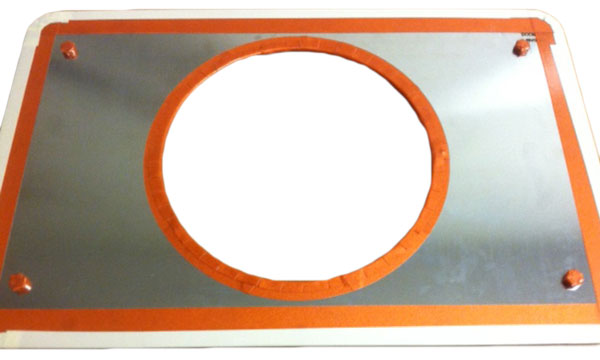
HVMT Orange Tape in use
HVOF Tapes
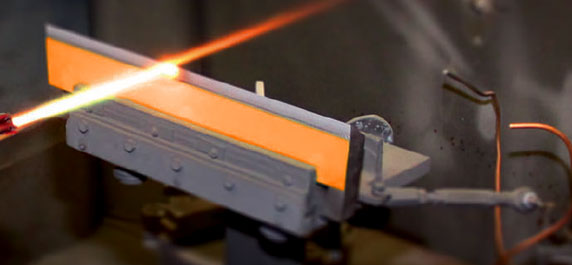
The high particle velocity of HVOF results in extremely high abrasion and a rapid transfer of heat through the masking materials. In order to mask effectively against HVOF, masking materials, including tapes, must be strong enough to withstand both the high abrasiveness and high heat. Green Belting™ HVOF Tapes are proven performers that hold up exceptionally well against the HVOF spray while offering high conformability, and clean, residue-free removal.
Specifically formulated for GF-HVOF masking applications, Green Belting thermal spray masking materials are designed and engineered for:
- Abrasion Resistance – The recommended tapes will resist high abrasion which allows for the masking material to maintain its integrity while also providing clear, well-defined coating lines with little to no distortion or fraying.
- Strong Adhesion of Tapes – Adhesion to metal is key priority for any tape surviving GF-HVOF. The HMVT series of tape has very strong adhesion to metal which allows the tape to stay in place during the spray process. This strength is what allows these tapes to resist the high kinetic energy or force associated with GF-HVOF. This tape has strong adhesion to metal and to itself. The result of the strong adhesion is a masking tape that will stay firmly in place with no lifting or flagging.
- Resistance to Heat Transfer – The recommended Green Belting tapes are designed to resist extreme heat while also limiting the transfer rate of heat through the material. This trait is especially important with the HMVT series of tapes as protection of the adhesive is a key factor in the survival of the masking tape.
- Highly Conformable – The key to an effective GF-HVOF masking is conformability. Competing tapes are very stiff which limits their effectiveness. Our recommended tapes and compounds will conform easily to mask difficult or complex profiles. Superior conformability allows Green Belting products to be used for applications where competing tapes simply will not work due to lifting.
- Clean Release – Green Belting tapes leave no residue on removal after blasting and spraying. Adhesive residue can be a major problem for some competing thermal spray masking tapes. Green Belting masking products leave no adhesive residue which results in no need for any extra clean up and/or rework.
Problems that operators typically encounter with GF-HVOF include: extremely high abrasion, fast transfer of heat through masking materials and high kinetic energy or force. A combination of Green Belting tapes and MSSA Masking Compounds can offer unique solutions to tackle these challenges.
Recommended materials: HVMT Orange Tape.
Plasma Spray Tapes

Extremely high temperature and high abrasion call for masking materials that must withstand these forces during expected ‘dwell time’ parameters. Masking materials, including tapes and compounds must remain in place, resist burning and edge lifting, and prevent unwanted overspray and/or damage to the part being sprayed. All Green Belting Industries Plasma Masking Materials are precision made with the highest quality Silicone, Fiberglass, Adhesives and Compounds to ensure optimum performance in this harsh setting. All are easy to work with, offer high flexibility and conformability, and can be removed cleanly and easily following the spray process, leaving leave no adhesive residue.
Green Belting masking tapes are engineered to meet the demands of a wide range of thermal spray coating processes, including plasma spray. They offer superior performance due to the following attributes:
- Abrasion Resistance – The types of coatings and thicknesses used are engineered to resist the abrasive forces of both the grit blast and flame spray coating processes. Green Belting tapes can be applied once for both grit blasting and flame spray coatings.
- Strong Adhesion of Tapes – Masking tapes exhibit high adhesion to metal and to themselves (to prevent flagging).
- Resistance to Heat Transfer – From the substrate to the coatings and adhesives, Green Belting masking materials are engineered to resist the extreme temperatures of thermal spray coating processes including plasma spray.
- Highly Conformable – Green Belting tapes are easy to work with and conform well to surface contours in more complex masking applications.
- Clean Release – Despite high adhesion, the tapes are designed to remove cleanly with no adhesive residue.

Recommended materials: 170-10S YL & 20S YL, 170-10S Green, 170-10S Red, 179-20S or 25S.
*Ongoing laboratory testing ensures that Green Belting Industries Thermal Spray Masking materials offer industry leading performance in measures of strength, resistance to extreme temperatures, resistance to abrasion, and adhesive performance (strength of adhesive on metal, face-to-back adhesion, and clean removal).
Specifications
HVMT Orange

Engineered for Gas Fuelled HVOF, this tape is is well suited for some of the most demanding thermal spray applications. Highly comformable for precision masking, it withstands extreme heat and abrasion and releases quickly and cleanly after use.
160 Fiberglass

Constructed with tightly woven high-tensile uncoated Glass cloth and Silicone Adhesive, this tape is ideal for Secondary Masking. It is highly conformable and leaves no adhesive residue upon removal.
162 Fiberglass

Ideal as an under wrap in demanding coating applications, this high temperature Fiberglass cloth tape has Silicone Adhesive on both sides. The tape removes cleanly after use and leaves no adhesive residue.
170-10S & 20S YL

The standard Thermal Spray Masking Tape withstands grit blast and thermal spray, and releases cleanly from metal surfaces. 170-20S YL offers double-layered protection for added strength and resilience.
170-10S & 20S Red

Well suited for Plasma Spray coating and applications involving higher temperatures, this tape resists burning and scorching while leaving clean coating lines and no adhesive residue.
170-10S & 20S Green

In most cases, just a single layer of 170-10S Green will withstand both the grit-blast and spray coating processes. For more demanding jobs, 170-20S Green provides an extra layer of protection.
179 Multi-Layer

This high temperature, abrasion resistant multi-ply tape is made with a Silicone / Glass layer laminated to a heavy gauge aluminium foil. The aluminium layer enhances conformability and produces clean edge lines.
190 Aluminium

Made with Aluminium Foil and Fiberglass cloth laminate, this specialized tape offers dual masking protection. It is highly conformable, releases cleanly from metal surfaces and leaves clean edge lines.
Specifications
| Product | Max. Width (mm) | Nominal Thickness (mm) | Adhesion to Steel | Adhesion to Shelf |
| Fiberglass Tapes | ||||
| 160-5S HT | 1219 | 0.19 | 3.3 N/cm,w | 5.8 N/cm,w |
| 162-7S | 914 | 0.18 | 3.8 N/cm,w | 3.8+ N/cm,w |
| 162-12S | 914 | 0.29 | 3.3 N/cm,w | 3.8+ N/cm,w |
| Silicon Coated Fiberglass Tapes | ||||
| 170-10S YL | 1219 | 0.28 | 4.4 N/cm,w | 3.3 N/cm,w |
| 170-10S Green | 1219 | 0.27 | 4.4 N/cm,w | 3.3 N/cm,w |
| 170-10S Red | 1219 | 0.28 | 4.4 N/cm,w | 3.3 N/cm,w |
| HMVT Orange | 1219 | 0.51 | 3.8 N/cm,w | 3.3 N/cm,w |
| Multi-Layer Tapes | ||||
| 170-20S YL | 457 | 0.52 | 3.3 N/cm,w | 2.7 N/cm,w |
| 170-20S Green | 457 | 0.52 | 4.4 N/cm,w | 3.3 N/cm,w |
| 179-20S | 330 | 0.52 | 3.3 N/cm,w | 2.2 N/cm,w |
| 179-25S | 330 | 0.64 | 2.7 N/cm,w | 2.2 N/cm,w |
| Aluminium Foil Tapes | ||||
| 190-7S | 1219 | 0.18 | 4.1 N/cm,w | 3.3 N/cm,w |
Bridging and Chipping
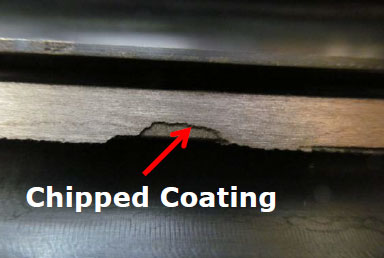
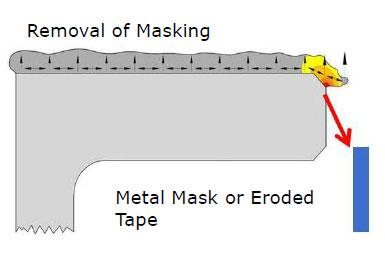
Problem: Coating edges are chipped meaning extra time is required to repair or re-work affected parts; high number of rejected parts; and increased costs.
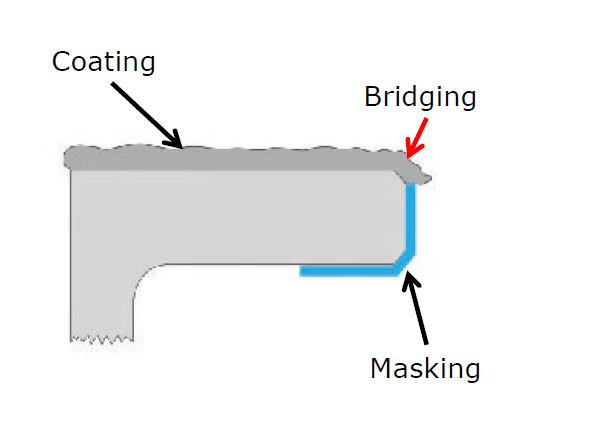
Cause of Problem: Inferior tapes or incorrect masking strategies. Metal masking and eroded tapes may lead to bridging. Thick tape or multiple layers of tape cause ledging and bridging.

Solution: Green Belting Tapes with low profile masking prevents ledging and bridging; the high tensile strength allows for single layer use; and allows you to tape with well-defined edging.
TIP: For critical jobs use a 1/2″ wide “sacrificial” layer of tape to be removed after grit blast (or removed during spraying process).
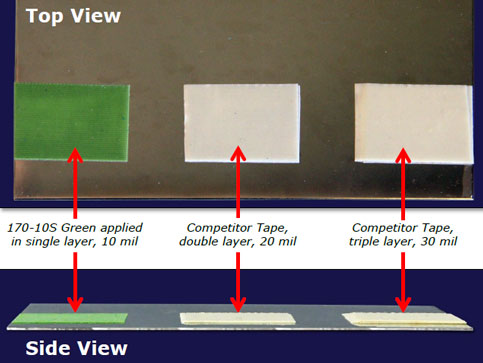
Green Belting plasma spray masking tape is often designed for single layer applications (10 mil thickness).

Green Belting’s higher tensile strength can allows for fewer tape layers, keeping the masking profile as thin as possible.
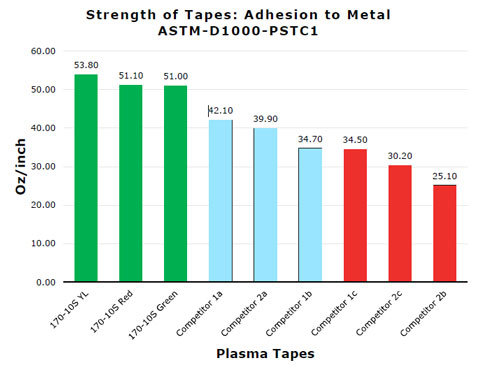
Green Belting tapes also have stronger adhesion, so only one layer is needed.
Face-to-Back Adhesion

Problem: Tape lifts during spray process/Tape liefts from itself on overlaps/Seams lift and tape unravels from component.
Cause of Problem: Adhesive loses strength when heated from spray exposure. Tape lifts from itself on overlaps due to low face-to-back adhesions. Seams lift and tape unravels from component as a result of low adhesion to metal performance.
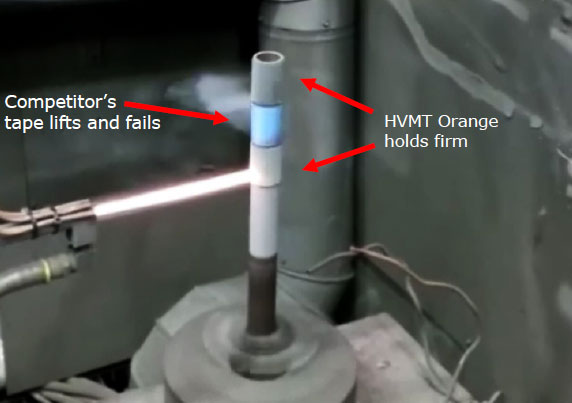
Solution: Strong face-to-back adhesion with Green Belting tapes. Tapes will not lift, neither will seams when single layer is used. Green Belting’s adhesive is designed to stick to itself. The top layer does not lift and overlaps remain intact if multiple layers are needed.

Related Masking Consumables
For related masking products, view our Metal Spray Masking Tapes and Metal Spray Plug & Cap Masking Consumables.
Contact us for more information on what tape is best suited to your particular application, call us on 07 3823 1004, or contact us via email using our Contact Form.