Heat Source
Electric Arc
Material
Wire
Transfer
Compressed Air
Process
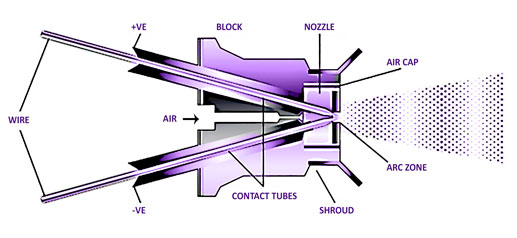
Arc spray (sometimes referred to as twin wire arc spray or thermal arc spray) is a process that uses an electric arc to melt wires. Arc spray systems are commonly considered to be easy to operate and to automate and are offered as “push” or “push/pull” systems. A “push” system pushes the wire to the gun, is lighter and easier to use than a “push/pull” gun and is generally used for engineering applications which use hard engineering wires and have a shorter distance from the machine to the gun (5 metres). “Push/pull” systems are used when a longer distance from the gun to the machine is needed and are typical for anti-corrosion jobs that use soft wires (zinc and aluminium). The systems push or pull two wires to the gun to be sprayed. The wires are forced together and form an electric arc, melting the wire. Compressed air passes through a nozzle which atomises the molten metal and sprays it onto the work piece. These wires are interchangeable and can be used as one wire zinc, one wire aluminium for example. The higher the current rating of the system, the higher the spray rate.
Arc spray is a very good, cost effective method to apply metallic coatings in a very wide range of applications and is one of the most versatile of all of the thermal spray processes. It is a simple process to provide corrosion protection coatings to steel fabrication or is as easily capable to provide engineering coatings to re-build or change the surface properties of the sprayed objects. Changing between anti-corrosion and engineering wires is quite simple. Coatings of zinc, aluminium, steels, copper, bronze and other materials can be sprayed for corrosion protection, engineering reclamation, surface modification and decoration. Capital costs of arc spraying are typically higher than flame spraying but the running costs are normally lower. The amount of material that can be sprayed is limited by the wire diameter and the available power of the machine but higher spray rates are achievable with arc spray than flame spray.
Arc Spray coatings can be applied to just about anything including Metal, Wood, Polystyrene, Plastic, Glass, Paper, Ceramics, as well as Chocolate (for demonstrative purposes only) and can be used in unlimited artistic applications. Arc Sprayed coatings also provide the ideal surface to receive any top-coating from painting to powder-coating with any available colour! The Arc Spray process is known for its low heat input when spraying. Low heating of the substrate makes arc spray useful when it comes to thermally sensitive substrates. The low heat input also eliminates the risk of component distortion. The below video will help to emphasise this low heat input by showing examples that would lose definition, distort, warp or even melt when subjected to a high temperature.
General Features
- 1.6mm to 4.76mm wire sizes (depending on which model is used).
- Low power consumption compared to plasma or HVOF.
- Simple push-button operation.
- Low heating of the substrate used makes arc spray useful when it comes to thermally sensitive substrates. For example, capacitors and electronic components.
- A range of porosity levels can be achieved to enable the coating properties to match the application requirements.
- Arc spray doesn’t require the use of combustion gases or produce a high-energy plasma; meaning that it poses fewer health and safety risks than other thermal spray processes.
- Arc spray process offers lower cost and high throughput coatings in comparison to the HVOF spraying process.
- Engineering applications.
- Anti-corrosion applications.
- Surface modification applications.
- Decorative applications.
- Manual or automatic operation.
- Robotic operation option available.
- Push/Pull synchronous drive gives outstanding wire feed reliability of up to 20m.
- The closed loop current control ensures reliable spray and ease of operation.
Application Examples
Arc Spray Systems can be used in a range of applications including, but not limited to:
- Aerospace engineering coatings.
- Al-Zn-In Coated Panels.
- Anti-spark coatings.
- Architectural fabrications.
- Architectural Forged Iron Ornaments Restoration.
- Balconies/railings.
- Bearing and seal surfaces.
- Boiler anti-corrosion coatings.
- Brake discs.
- Brake drum reclamation.
- Bridges (concrete and steel).
- Caterpillar V12 Engine Block Reclamation.
- Cathodic protection of steel in concrete.
- Capacitor ends.
- Cellulose pressure roll.
- Ceramic objects.
- Children’s playground equipment.
- Coal rippers.
- Conductor rolls.
- Construction piles.
- Cookware reinforced stainless steel coating system.
- Crane wire barrel.
- Crankshaft reclamation.
- Ductile iron pipes.
- Earthing of resin insulators.
- Electrical towers.
- Electric motor armature.
- Engineering bond coats.
- Exhaust gas stacks.
- Fences / gates.
- Forklift and earth mover brake drum clutch housing.
- Glass reinforced plastic (GRP).
- Helicopter landing platform.
- Hydraulic pit props.
- Infrastructure.
- Iron and steel protection at elevated temperatures.
- Livestock/Cattle Trucks.
- LPG cylinder spraying.
- Manhole covers.
- Marine diesel engine piston.
- Mill roll journals.
- Mould manufacturing.
- Multi-void Aluminium Tubing for AC Condensers.
- Nickel electroforms.
- Natural gas compressor crossheads.
- Non-slip coatings.
- Nuclear applications.
- Offshore/oil & gas.
- Open cell foam.
- Paper mill rolls.
- Petrochemical processing site.
- Plastics.
- Polystyrene.
- Polyurethane foam.
- Railway coach axles.
- Railway hopper wagons.
- Railway tracks.
- Reclamation of ball bearing seats on rubber coated print rollers.
- Reclamation of Blanket Cylinders Web Offset Litho Press.
- Reclamation of hydraulic rams.
- Reclamation of propeller shafts.
- Reclamation of rudder posts.
- River and canal vessels.
- Road sweeper body.
- Rocket engine components.
- Rotary furnace support rollers.
- Run out rollers.
- Sewage purification plant.
- Ship walkways.
- Shaft repair/resurfacing.
- Shipbuilding/marine.
- Soap chilling cylinder repair.
- Structural steelwork.
- Subsea riser pipes.
- Sulphur dump drums and pipes.
- Textiles/fabrics.
- Tow truck tilt slide trays (anti-slip).
- Train stations.
- Transport pipes.
- Vehicle chassis.
- Unloader shafts.
- Vessels and enclosures.
- Wear coatings.
- Wind turbine towers.
- Wood.