Heat Source
Fuel (Liquid or Gas) and Oxygen Flame
Material
Powder (Metal)
Transfer
Via the Flame
Process
The Hypersonic Spray Process / High Velocity Oxygen Fuel (HVOF) is a process to apply very dense, strongly adhered coatings. A fuel (commonly kerosene or hydrogen) is mixed with oxygen and ignited in combustion chamber. The combustion gases are accelerated through a nozzle. Powder is introduced into the gas stream where it softens and gathers speed before coating onto the sprayed surface. These coatings are commonly used as a hard chrome replacement process and produce very dense, hard wearing coatings. Metallisation offer two variants of HVOF Pistol Control Consoles to operate either liquid fuel or gas fuel pistols.
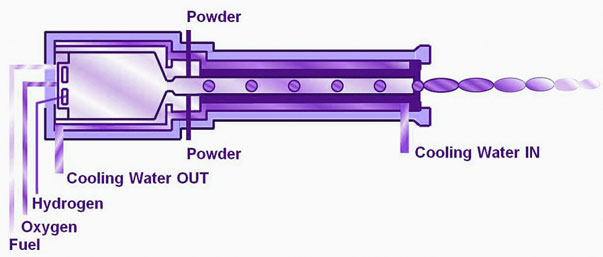
The gas stream heats and accelerates the powder particles to around twice the speed of sound, simultaneously softening them. They impact onto the sprayed surface with tremendous energy to form a very dense, strongly adhered coating.
There is always a demand for more wear and corrosion resistant surfaces and for these reasons High Velocity Oxygen Fuel (HVOF) spray systems are becoming increasingly popular. Unlike the other methods of metal spraying, where the feed stock is melted and projected onto the substrate, the HVOF process simply softens the powder before projecting it. This is because less heat is imparted to the particles and the dwell times are very short, oxidation and decomposition are minimal in a HVOF coating. The main difference which provides the superior quality, is offered by the use of a combustion chamber and accelerating nozzles that produce very fast (approx 1500m/sec) particle velocity that results in high impact energy and hence reduced porosity levels as when compared with other metal spray processes.
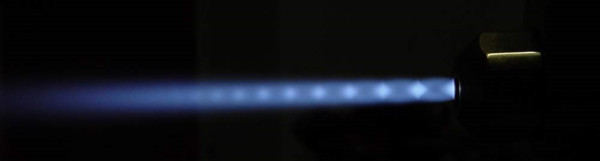 |
| HVOF Flame with shock diamonds producing the necessary speed for high impact deposits. |
The use of low level porosity coatings combined with hard wearing, corrosion resistant, conductive and high bond strengths allow the process to be used in many applications for a variety of industries including Paper, Pump, Aerospace, Mining and Oil.
The coating density for most metallic coatings will be more than 99.5% of the theoretical density, micro-hardness in excess of 1300 HV300 are commonplace and the bond strengths are beyond the normal values measurable by the ASTM 633 test.
Features
High Velocity coatings produce not only harder, denser carbide coatings, but are also more ductile. Due to the lowered particle temperature there is less shrinkage and this combined with a simultaneous peening effect as the next particle arrives, produces lower residual stresses and enables a much greater thickness to be applied. These properties make the coatings significantly more wear resistant, especially where loads are high or erosion is prevalent. Normal Plasma type coatings usually fail due to the break up of the coating and not through wear of the particles. A resistant barrier layer provides the corrosion resistance of the alloy materials, hence the reason why coating density is so important. High Velocity Systems ensure there is no degradation.
HVOF coatings can apply materials that include Tungsten Carbide which makes coatings with exceptional wear protection – up to 10 times greater than hard-chrome plating for example. The process lends itself to high value applications, significantly extending the life of components such as mud rotors, gate and ball valves in the oil/gas sector or hard chrome replacement of aircraft landing gear or hydraulic pistons.
- Retention of powder chemistry due to the reduced time at temperature.
- There is lower oxide content due to there being less in-flight exposure time.
- There is higher density (lower porosity) due to there being greater particle impact velocities.
- Improved corrosion protection due to there being less through-thickness porosity.
Benefits of HVOF with Typical Coatings
- Tungsten Carbide – If this material is overheated, not only does it oxidise and lose carbide to carbon dioxide, but the carbide also becomes dissolved with in the Cobalt Matrix. The resultant mixed Tungsten/Cobalt Carbides are hard, but brittle. In some circumstances this is not very important, for example, when impact loads are low and wear is by stress abrasion. On the other hand, in applications such as tool and die parts and compressor blades subject to hammer wear, ductility as well as harness is required.
- MCrALY’s – are a family of high temperature oxidation resistant alloys which are used in gas turbines. They offer protection by readily forming an adherent oxide film on their surface, which delays further oxidation. However, this readiness to form oxides means that normally coatings will contain oxidised particles. Research has shown that these oxide layers around the particles act as a path for further oxidation and penetration of the oxidising medium to the substrate. The lower the oxide contents of the coating, the better. Oxidation rates follow a parabolic law. In other words, if the temperature is doubled the oxidation rate goes up by four times. Thus, if the particle temperature can be kept lower the oxide content is significantly reduced.
- Corrosion Resistant Alloys, e.g. Inconel 625 – These alloys provide corrosion protection by providing a resistant barrier layer. Therefore, coating density is very important and once again, oxide layers form paths along which the corrosion medium can migrate. Therefore, once again, a low temperature, high velocity process is appropriate.
Applications
As would be expected from such a coating system, the applications are wide and varied:
- Agitator Paddles.
- Aircraft Landing Gear.
- Aluminium can be Sprayed Very Densely.
Coatings of 7mm have been achieved and subsequently finely machined. - Ball Valves Reconditioning.
- Calendar Rolls.
- Compressor Repair.
- Corrugated Paper Rolls.
- Crankshafts Refurbishment.
- Damaged Shaft Repair.
- Francis Runners – Wear Resistant Coatings.
- Gas Turbine Compressor Seals and Automotive.
Turbochargers benefit from the application of an Aluminium/Polyester Powder Blend applied by the High Velocity Process. - Hard Chrome Plating Replacement.
For many years, hard chromium plating has been widely used in fluid handling and hydraulic applications. It has been proven to give adequate wear resistance in many cases and to provide an appropriate surface against which fluids may run. However, many situations exist where performance can be radically improved, whether in terms of pure wear or in combination with corrosion resistance. Thermally sprayed coatings are available in such a wide selection of materials and to such quality as to be able to exceed the requirements of almost any hard chrome application. The health and safety aspects of plating with hexavalent chromium have also been an increasing cause for concern. So much so, that some institutions intend to ban its use entirely. Thermally sprayed coatings do not produce effluent that is difficult to dispose of and the plant involved does not contain thousands of litres of toxic chemicals. It is also an ‘in-line’ process rather than a batch process so that material is only used or stocked during production. A further point worth noting is that the size of component for thermal spraying is not limited by the size of the otherwise plating bath. - Hard Surfacing.
- Hydraulic Cylinders.
- Incinerator Firewalls are Protected from Corrosion.
At medium temperature by coatings of Inconel 625 and super-heated tubes by Chromium Carbide in a Nickel based matrix. - Kaplan Turbine Blades.
- Mining Truck Front Strut and Wheel Spindle Reclamation.
- Other Plating Operations can also be Replaced.
Copper can be sprayed for inking rolls in the Printing Industry as well as providing excellent electrical conductivity properties for a variety of applications (for example). - Pelton Runners.
- Piston Rider Bands.
- Piston Rods.
- Pump Components.
Either as OEM or repair can be given enhanced lifetime and improved performance using a Nickel/Chrome/Iron/Molybdenum. - Pump Rotors.
- Sludge Dryer Cylinders.
- Turbine Shaft Repair.
- Valves and Pumps Subject to Erosive Wear.
From particles such as sand or ash etc can be protected using Tungsten Carbide/Cobalt/Chromium materials resistant to both wear and corrosion and in special circumstances Stellite 6 can be sprayed as a replacement of a weld clad overlay. - Wear Resistance.
As more and more Engineers become aware of availability and capability of High Velocity Systems then the applications for the process will surely grow well beyond its existing market. Our video presentation below demonstrates the Hipo Jet 2700 HVOF system coating a pipe using MSSA HV 40/60.
For more information on our equipment or consumables, call us on 07 3823 1004, or email us using our contact form.