Corrosion, wear, and erosion resistant coatings are a necessity for the Petrochemical industry.
Corrosion, cavitation, and pipe erosion are caused through transportation of the material during the drilling, refining, transport and extraction processes. The Metal Spray process is used today to combat these issues.
Casings and pump impeller life expectancies can be greatly increased with the application of the correct engineered surface coating. Mixers, screws and conveyor components can be coated to ensure that their efficiency is optimised. Gate valves, slides and seats suffer wear from cavitation, erosion and corrosion but can be enhanced with many nickel based alloys along with Tungsten Carbide hard-surfacing. Part configuration and finishing requirements influence the possible solutions for these types of components.
HVAF Alloy Coatings to Protect Petrochemical Heat Exchangers from H₂S and CO₂ Corrosion
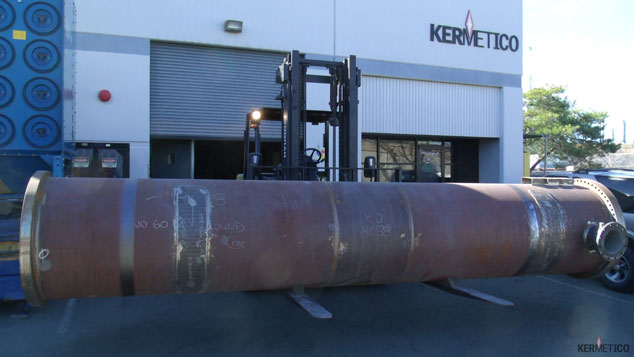
Petrochemical plants operate multiple heat exchangers exposed to corrosion due to the presence of hydrogen sulphide and carbon dioxide containing fumes and moisture in varying temperature conditions. Categorized as pressure vessels, the heat exchangers are usually made of mild carbon steels with low corrosion resistance.
Kermetico HVAF thermal spray equipment and technology provide a way to mitigate H2S, CO2 and other types of corrosion of heat exchangers and piping by depositing dense metal coatings onto internal surfaces.
Thermal Spray Corrosion Resistant Coatings for Heat Exchangers
The application of a Kermetico HVAF corrosion resistant thermal sprayed coating to the interior surfaces of a heat exchanger forms a barrier between the carbon steel and the sour process fluid preventing corrosion of the heat exchanger shell. Unlike a sacrificial thermal spray coating that is designed to corrode preferentially to protect the substrate, a barrier thermal spray coating needs to completely block the fluid’s corrosive constituents from attacking the base metal. The porosity and the density of the applied coating are important considerations for preventing corrosion of the substrate. Kermetico HVAF thermal spraying is an industrial coating process that uses a chemical (flame) heat source to preheat a powder coating material and spray it onto surfaces. Depending on the corrosion activity of the environment and the planned equipment lifecycle, different HVAF coatings could be applied onto a surface, anything from stainless steel to Hastelloy-type.
A Case of a Heat Exchanger Suffering from Sour Gas Corrosion
Mild steel petrochemical equipment treating sour compounds is subject to severe H2S and SO2 corrosion. Refinery owners decided to protect all their new heat exchangers from corrosion with a Kermetico HVAF Hastelloy-type coating. The inner surface of the heat exchanger was robotically HVAF grit blasted with our AK5 gun and the coating was robotically applied with the same gun.
Completion: 2013, shop application.
Application Method: Kermetico HVAF blast and spray technology. The rotation of the vessel was on rollers with a robotic traverse of the gun on an internal beam.
We have sprayed the cover in rotation with the robot.
We have coated the nozzles with a manual traverse fixture using the Kermetico HVAF AK5 system.
Spray Material: Pre-alloyed (gas atomized) Hastelloy-type powder.
HVAF Blasting Process (Grit: Alumina 150 Mesh; Blasting to “White Metal”)
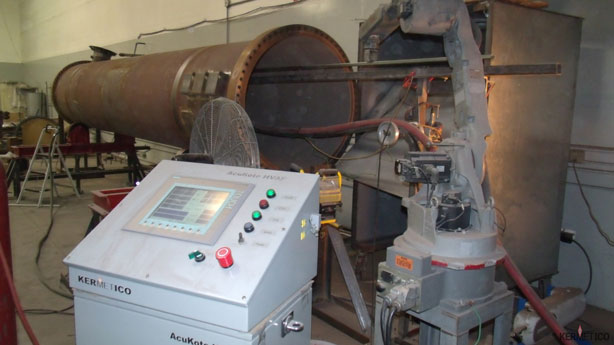
From rusted surface to “ready to spray” in a single pass!
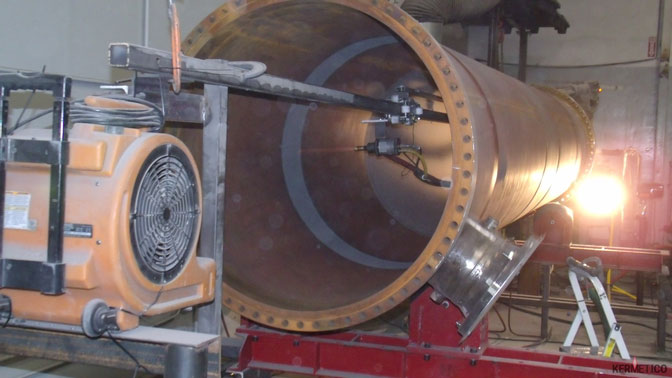
HVAF Spraying Process: Vessel ID
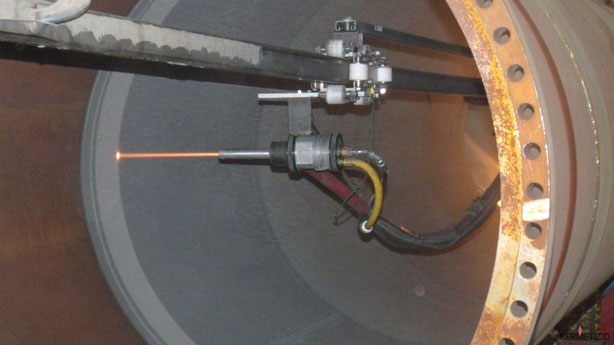
The Kermetico HVAF AK5 System Depositing a Hastelloy-type Coating onto an ID
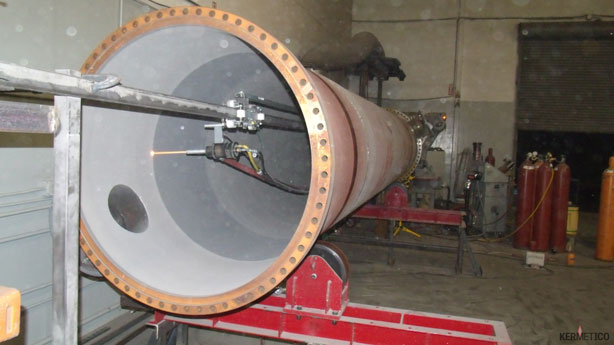
HVAF Spraying Process: Head and Nozzles
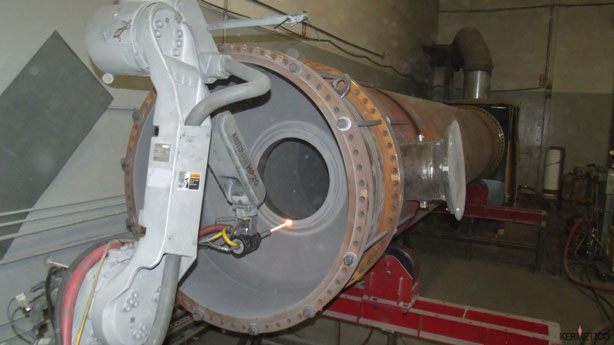
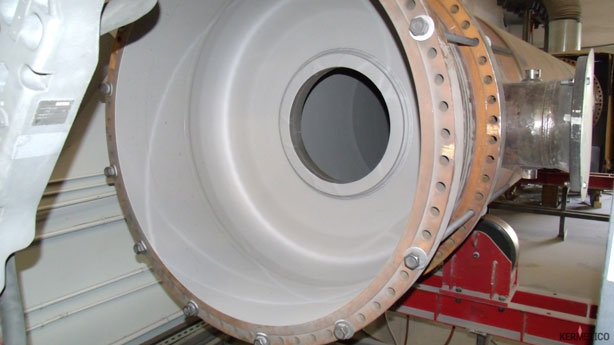
Heat Exchanger Coating Completed
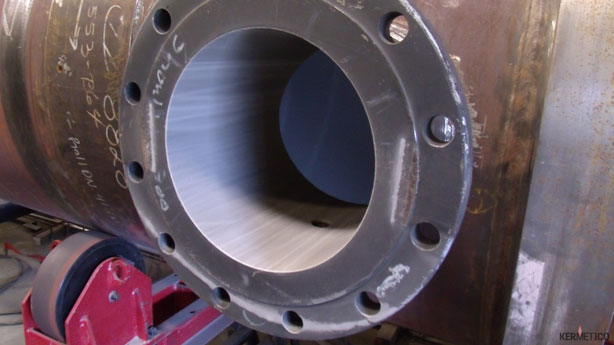
After three years in operation, the heat exchanger coating is intact and remains in service.
For more information, Click Here.
HVAF H₂S Resistant Coating to Protect Pressure Vessels from Corrosion
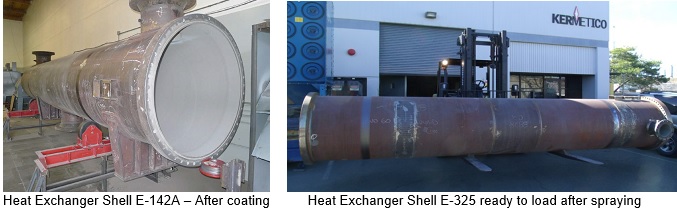
A refinery sulphur recovery plant operates multiple pressure vessels exposed to H₂S and CO₂ corrosion due to the presence of hydrogen sulphide and carbon dioxide containing fumes and moisture in varying temperature conditions. Categorized as pressure vessels, the towers, absorbers, condensers and channels are frequently made of mild carbon steel with low corrosion resistance.
Kermetico HVAF thermal spray equipment and technology allows depositing dense metal H₂S resistant coating to mitigate H2S and CO2 corrosion of pressure vessels and piping.
Coatings Protecting Refinery Pressure Vessels from H2S Hydrogen sulphide Stress Cracking (SSC)
There is a need to extract hydrogen sulphide from oil and gas in petrochemical processing. H2S corrosion, or sour corrosion, occurs when H2S gas reacts with carbon steel in a wet and sour environment. In the case of sour corrosion, hydrogen atoms formed during the corrosion process at the metal surface diffuse through the surface of the carbon steel and become trapped at laminations caused by voids and nonmetallic inclusions. When atomic hydrogen is absorbed by solid metals, hydrogen-induced cracking (HIC) can result. The hydrogen atoms combine to form molecular hydrogen (H2), which creates pressure from within the metal. Trapped H2 gathers at these locations and forms blisters as pressure builds. Eventually, cracking occurs when several hydrogen blisters connect in the base metal.
Several mitigation methods are known to prevent sulphide stress cracking and hydrogen induced corrosion. One is to perform a stress-relieving treatment on the metal to reduce hardness levels to acceptable levels in an annealed microstructure. A second method is to clad the carbon steel linings and welds with a corrosion-resistant alloy. Cladding the interior of a treatment column with a thermal spray-applied corrosion resistant alloy would form a barrier between the carbon steel and the sour process fluid and prevent sour corrosion, which would stop the formation of hydrogen atoms and their subsequent migration into the steel. Unlike a sacrificial thermal spray coating that is designed to corrode preferentially to protect the substrate, a barrier thermal spray coating for this application needs to completely block the fluid’s corrosive constituents from rusting the base metal, so porosity and density of the applied coating are important considerations for preventing corrosion of the substrate. Kermetico HVAF thermal spraying is an industrial coating process that uses a chemical (flame) heat source to preheat a powder coating material and spray it onto surfaces. Depending on the corrosion activity of the environment and the planned equipment life-cycle, different HVAF coatings could be applied onto the surface from stainless steel to Hastelloy-type.
A Case of a Petrochemical Refinery Sulphur Condenser Sour Gas Corrosion
Mild steel petrochemical equipment treating sour components is subject to severe H2S and SO2 corrosion. The sulphur condenser outlet channel suffers extensive pitting due to dew point corrosion caused by condensation of sulphuric acid on the “cold spots” where the metal surface temperature drops below 120°C (248°F).
After successful testing in boiling concentrated sulphuric acid media the Hastelloy – type Kermetico HVAF coating of 0.25 mm (0.010”) thickness was specified for application on the complete inner surface of the outlet channel (1.8 m (6’) diameter, 2.7 m (9’) long), with a gas outlet (0.76 m (2.5’) diameter, 0.3 m (1’) long) welded to it as well as on the channel cover (1.8 m diameter). We have robotically HVAF grit blasted the inner surface of the channel with the AK7 system, and have robotically applied the coating everywhere except for the masked areas for welding of the demister frame and plates.
Following the welding of the de-mister support structure, the welds were sprayed with the manual Kermetico HVAF AK-HH gun. After installation of the channel at the plant, the customer flame-cut a hole in the bottom through the coating and welded the liquid sulphur outlet to it.
Finally, the corrosion resistant coating was applied over the cut area and inside the liquid sulphur outlet with a hand-held AK-HH gun on-site. After five years in operation, the H2S resistant coatings on the channel and cover are intact and remain in service.
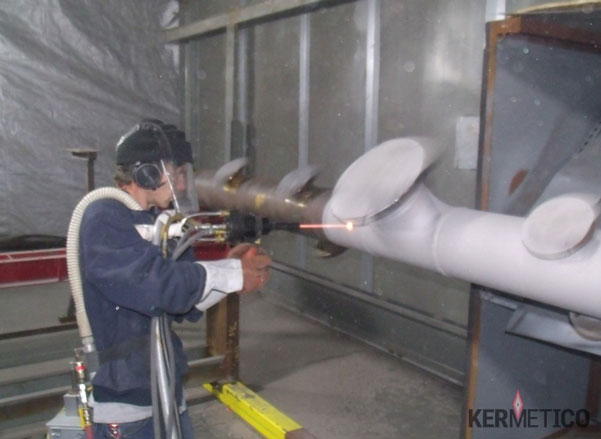
Spraying a Hastelloy C-type coating onto a Manifold with the Kermetico HVAF AK-HH Handheld Gun
For more information, Click Here.
Anti-Spark Coatings on Crane Hooks

Reason for use: To remove the potential for sparking between two steel components.
By using the Metallisation Arc or Flame spray Process, it is possible to remove this major source of spark hazard by applying a thin layer of phosphor bronze onto the offending surface. One of the most common components to be treated in this way is crane hooks, but it is also possible to apply this type of coating to steel fan housings or forklift truck forks. Metal spraying is an economic method of producing a spark resistant surface on any standard manufactured steel component.
Equipment: In this case Arc Spray Equipment was used.
Materials: Phosphor Bronze Arc Wire – Easily machinable material, very good for bearing surfaces and giving an excellent anti-spark coating.
Method – Cleaning
- Steam clean if equipment available.
- Degrease by solvent vapour process, if material available.
- Check all surfaces are free from contamination and debris.
Preliminary Inspection
Check for cracks or surface imperfections taking hooks below the manufacturers recommended operating tolerances.
Preparation
- Mask surfaces adjacent to area requiring treatment with a heavy duty masking tape.
- Thoroughly inspect for contamination prior to blasting.
- Thoroughly blast the area to be sprayed with clean chilled iron grit grade G24.
- Ensure that areas to be treated are thoroughly blasted A surface profile of between 75μm-100μm should be achieved. It is important that the surface to be sprayed should not come into contact with hands, oil, grease or other contaminants which may cause bond failure after spraying. Delays between blasting and spraying should not exceed 20 minutes.
Application of Sprayed Coating
Bonding and Simultaneous Spraying of Phosphor Bronze.
- The Arc Spray Equipment should be set up in accordance with the MSSA manual for the spraying of Phosphor Bronze.
- The area to be sprayed should be cleaned with a vacuum cleaner or a clean, dry air blast to remove any loose particles of dust or grit.
- The first 75μ-100μm should be applied at close range (typically 100mm) and at lower air pressure to achieve a higher bond strength.
- The coating should be applied evenly by rotating the component in front of the Arc spray Pistol, keeping the spray-stream at as near as possible to 90° from the surface being treated.
Bond Coat
Spraying parameters for Bond Spraying Phosphor Bronze.
- Range: 100mm
- Nozzle Air Pressure: 3.7 bar (55 psi)
- Volts Before Spraying: 32-34V
- Volts During Spraying: 28-30V
- Current: 200A
Note: Parameters may differ in accordance with type and length of power cables and hoses being used.
Main Deposit
- Apply Phosphor Bronze final deposit to specified required thickness (typically 0.40-0.50mm).
- The coating should be applied evenly by rotating the component in front of the Arc spray pistol, keeping the spray-stream at as near as possible 90° from the surface being treated.
Spraying parameters for Main Deposit Phosphor Bronze.
- Range: 150mm
- Nozzle Air Pressure: 4.3-4.6 bar (62-87 psi)
- Volts Before Spraying: 32-34V
- Volts During Spraying: 30-32V
- Current: 250A
De-Masking
- Remove all masking tape.
- Remove all over-spray taking care to prevent coating damage.
Inspection
- Check dimensions.
- Check for cracks, defects in sprayed coating, i.e. large pores or protrusions and loose particles.
Finishing
Under normal circumstances, it is possible to use the component in the as-sprayed condition without any problems but for cosmetic purposes, a light polish may be required.
Using TSA to Protect Pipelines from Corrosion Under Insulation (CUI)
Reason for use: Cost effective corrosion protection against aggressive corrosion under insulation (CUI).
In the petrochemical industry Corrosion Under Insulation (CUI) in pipeline systems consumes a significant percentage of the maintenance budget. A large portion of this money is spent on expensive items such as external piping inspection, insulation removal and re-installation, painting and pipe replacements. CUI prevention strategies provide long term and reliable prevention of CUI that move towards inspection-free and maintenance-free piping systems and significant maintenance cost reductions.
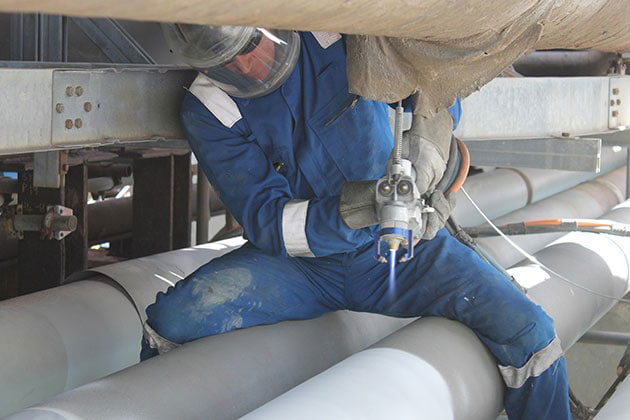
Coating with TSA (Thermal Sprayed Aluminium), using Metallisation flame spray equipment is one method that a number of operators within the petrochemical industry have adopted. TSA is found to be a cost effective solution compared to other systems when reviewed over the lifetime of the facility. One of Metallisation’s customers has an ongoing programme for applying TSA at a petrochemical plant, as a solution for the long term protection against atmospheric corrosion and CUI.
One specific project is a three quarter mile long marine jetty pipeline that is used for the transportation of lube oil and is exposed to the harsh marine environment. Other projects on this site have included a full range of pipes and vessels, including work on live operating plant.
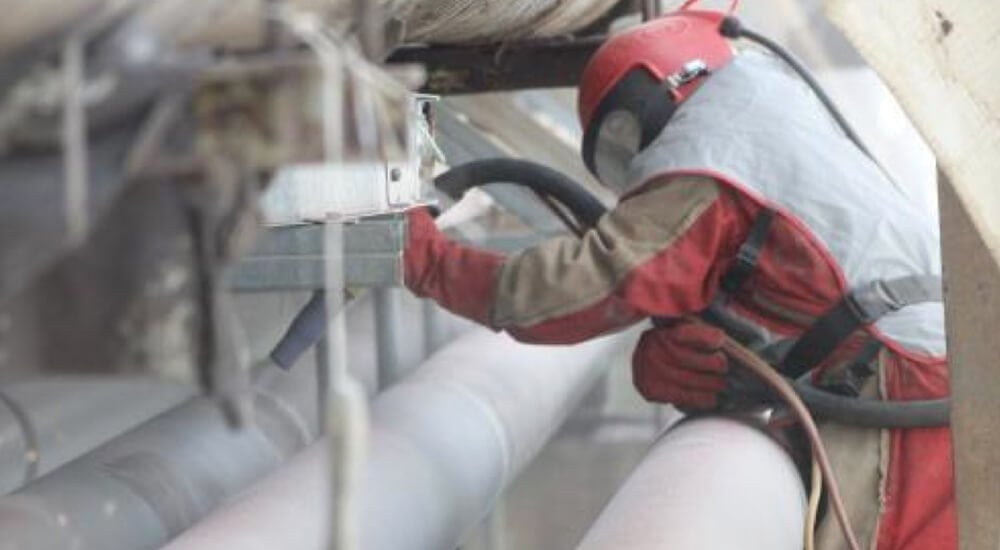
To ensure the success of the thermal spraying process, the preparation of the pipeline surfaces is critical. For this project the pipeline surface was prepared by grit blasting with garnet to give a sharp angular profile for the TSA to bond to. As part of the QA/QC process, the blast profile was regularly checked using Testex tape to ensure it meets the required 75-125 micron specification.
The grit blasted surface was then given a visual inspection, using 10x magnification, to check the surface cleanliness and finish. The pipes are also given a ‘tape test’, which checks for dust contamination of the blasted surface. The tape sample is then visually inspected against white and black backgrounds for signs of dust particles. The final quality test is a salt contamination test.
Using a small flexible container a minimal amount of testing solution is applied and agitated on the surface of the blasted pipe. This solution is then checked for the presence of salt using a test kit pipette. Once all of these tests have been passed the pipelines are ready to be thermal sprayed with aluminium.
A huge advantage of the Metallisation equipment and process is the flexibility and long supplies, which provide a safe working environment and ease of use for the operators. In this project the gas bottles and compressor were situated in a remote supply area, which gave easy access to the gas cylinders and enabled manifolding for fewer cylinder changes. In elevated applications such as vessels and towers, the cylinders can remain on the floor while the spray system is elevated tens of metres.
This situation therefore requires less complex scaffolding as the heavy bottles are not scaffold mounted. The 30 metre supply package, consisting of gas, oxygen and air, was fed from the overhead supply area down to the control panel. The pistol is then a further 10m away from the control panel. This setup allows around a 60m length of piping to be sprayed without having to move the cylinders and air compressor, giving significant productivity benefits in a very difficult environment.
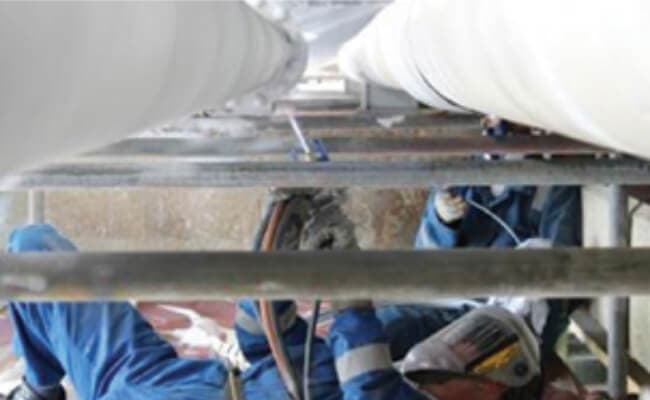
The contractor on this specific job site is using two Metallisation Flame Spray systems in different spray locations. Once the blasting and inspection is completed, the TSA application starts. Typically, blasting and inspection is completed in the morning taking approximately four hours.
The TSA is applied in the early afternoon for around three hours and the final sealant application at the end of the day. The TSA is applied with a methodical work pattern with the pipe topside coated first, then the underside. The long supplies package allows the sprayer and wireman to move freely around the worksite in the most efficient manner to suit the specific area.
The MK73 deflected extension is perfect for those difficult to access areas commonly found at petrochemical sites and has been designed specifically for this application area. It comes in three lengths – 150mm, 300mm and 450mm. The extension unit can spray directly forward or at a deflected angle up to 90o by varying the deflector air pressure. The deflection nozzle can also be rotated through 180o to allow spraying in a 360o arc around the pistol. The long supplies system provides flexible working conditions, particularly useful when spraying the underside of the pipes.
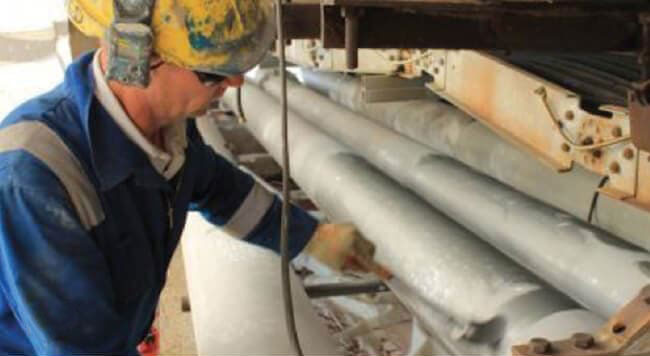
Following the application of the TSA, the pipelines in this specific application were sealed with Intertherm 50 sealer, which was applied until full penetration was achieved. In some CUI related environments, no sealer is applied, especially where the spray area is operational and hot.
During the application of the TSA the operators periodically checked the coating thickness using a DFT gauge and made appropriate corrections along the way. The specification for this particular job was 250-500 microns. The QA/QC Inspector for the project also checked and recorded the coating thickness throughout the process. To support the QA/QC process the spray operators produced witness plates on a daily basis, which were then tested for adhesion to ensure it met the minimum 1000 psi – 6.9MPa coating thickness. Audit bond strength testing was also carried out periodically on the actual sprayed pipe sections.
Thermal spraying involves the projection of small molten metal particles onto a blast prepared surface. Upon contact, the particles flatten onto the surface, freeze and mechanically bond, firstly onto the blasted substrate and then onto each other, as the coating thickness is increased. To create the molten particles, a heat source, a spray material and an atomisation/projection method are required, in this instance the customer opted for the flame spray process.
Chevron Plunger Pump – Kermetico Case Study
This case study is about a three piston plunger pump used to pump “gack”. Gack is a term used to describe a substance that has a variable composition and is generally bad for the equipment it comes in contact with, particularly pumps. In this case the gack consisted of water and various unspecified and unknown petroleum products and byproducts with varying amounts of particulate.
The first time we saw the plungers was October 4, 2011. The set of three arrived with a NiCrBSi fused coating applied by others. We were told that the plungers had been in service for only a year. Here is what they looked like:
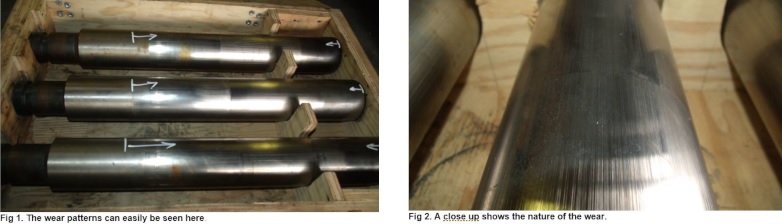
The scoring was from “mystery” particulate trapped between the plunger and the packing. This led to leakage and the need to repair them.
We ground off the old fused coating and found that one of the three had to be taken well below finished dimension in order to remove all of the original coating. In order the keep the price of the job within reason we first built up a layer of NiBSi 0.45 mm (0.018”) thick followed by a layer of tungsten carbide cobalt chrome (86-10Co-4Cr) 0.40 mm (0.016”) thick, which was finished ground back to 0.25 mm (0.010”) thick per side.
The other two were coated with only tungsten carbide and finished to a thickness of 0.25 mm (0.010”) per side.
Below are how they looked during and after processing, ready to go back into service:
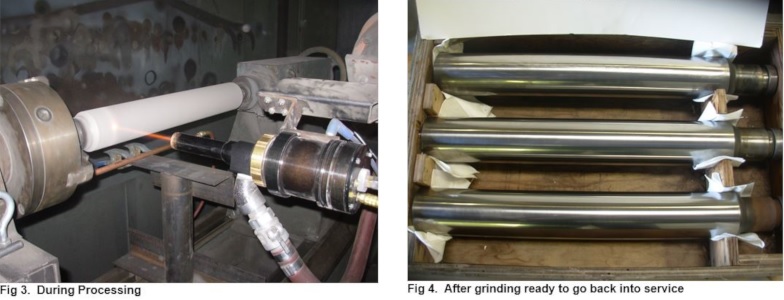
That was the last time we saw them until March 24, 2016, when two of the original three were returned for re-servicing.
Here is what one of the two returned plungers looked like after 4.5 years of service.

The first plunger failed because the seal (packing) lost lubrication and the plunger overheated severely. This was the plunger that required a layer of Ni to reduce the thickness of carbide applied. The carbide failed at the Ni layer. The second plunger also lost lubrication but much later than the first one. The defect you see is from ‘gack’ under high pressure escaping from under the seal and eroding the coating much like high pressure water jetting.
The third unit did not have a lubrication failure and is still in service.
Measurements of the failed plungers in areas where there is no erosion or coating failure due to overheating are IDENTICAL to the finished dimensions when they left our shop in 2011!
Zero wear suggests that if the lubrication system hadn’t failed these plungers would have been in service for many more years.
The sleeves that hold the packings that these plungers ride in have pretty much the same story. Two of the three failed and the one that didn’t have lubrication problems is still in service. We will be coating the ID of those two and they will become spares.
The two sleeves in for repair did have a little less than 0.001” of measurable wear in the area where the packing sits. The wear was caused by the packing getting loose and moving with the piston. There is also evidence of some ‘water jetting’ damage as well.
And the best part is that the coating of 86-10-4 that we are applying today is significantly better that the coating that was applied to these plungers. Back then the hardness was in the range of 1350-1375 Hv300, and today it is in the range of 1450-1500 Hv300.
Process Slurry Pump – Case Study
Background: We were asked to coat a slurry pump backing plate to protect it from the abrasive slurry passing through the pump. The slurry consists of gypsum, aluminum oxide and water. The impeller came from the manufacturer already coated with tungsten carbide presumably by a HVOF process. The pump housing was uncoated and the customer didn’t want the housing coated as in previous experience with this pump in this application the backing plate was the only part adversely affected by the pumped slurry.
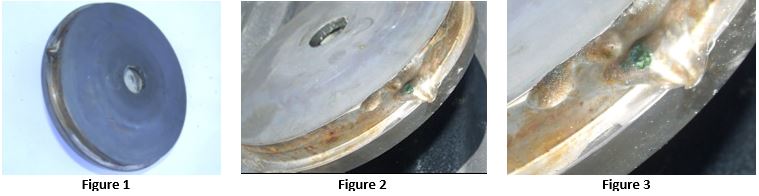
Results: Here is the backing plate with the as applied HVAF tungsten carbide coating after one year of service (Figure 1).
After measuring the coating thickness we found that the thickness after one year of service was identical to the original applied coating thickness. As we began to examine the backing plate we found an interesting area seen below (Figure 2).
The backing plate seal to the housing wasn’t absolute and some erodent made it past the coated surface of the backing plate and eroded material from under the coating. It is hard to see in the photo but the coating is undercut and is still intact forming a sharp overhang of coating. Here is a close up of the eroded area (Figure 3).
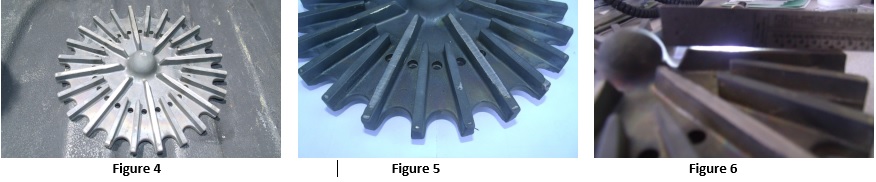
The other main parts of this slurry pump didn’t fare as well. The impeller shown below lost much of the applied coating and the blades were wearing away fast. If the pump didn’t begin leaking the impeller would have failed after little additional service. Here is a look at the impeller (Figure 4). In the close-up view you can see were the HVOF coating is completely gone (Figure 5). In those areas where the coating is worn away the metal is being worn away quickly as those blades are significantly shorter than the adjacent blades that still have coating remaining on the surface. This can be seen using a straight edge and a little back lighting (Figure 6).
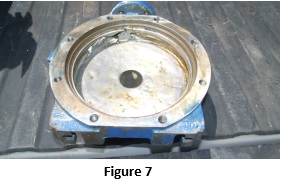
The pump case didn’t do well either. Here is a look at it as received (Figure 7).
The damage is readily apparent in Figures 8, 9 & 10, where closeup views shoe the extent of the damage.

Sulphur Dump Drums & Pipes – Refinery
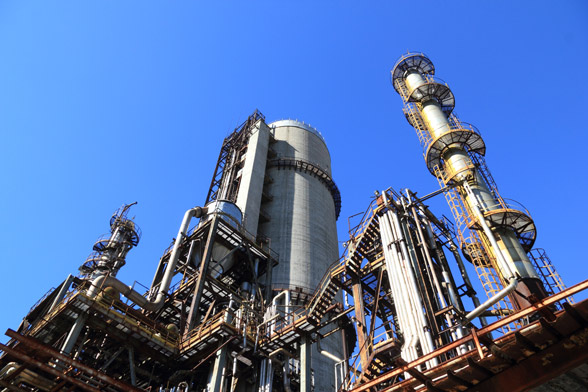
As well as protection against external corrosion, metal-sprayed coatings have been applied to the internal surfaces of pipes and vessels. The internal surfaces face corrosion as they are exposed to moisture and oxygen, particularly at the sulphur ‘splash zone’.
The sulphur dump drums and pipes, used to store and transfer sulphur in a refinery, were sprayed using the Arc Spray 140 and Arc Spray 700, for corrosion protection. Again, the surface was blasted to SA 2.5 cleanliness and sprayed with aluminium to a thickness of 350µm. The aluminium was then sealed with a high temperature Silicone Aluminium sealer over a total surface of 1681m². As the coatings were internal and not visible, no painted topcoat was required. The project took over two months to complete.
Various other structures have also been sprayed as part of the project including condensers and other drums, vessels and pipework. Discussions are ongoing between APS and the customer regarding the future projects, which can benefit from metal-sprayed coatings to give long-term corrosion protection.
Petrochemical Processing Site
Above Image for Decorative Purposes Only
APS completed a major project at a new petrochemical processing site in Saudi Arabia. Three of the vessels, totalling 3000m², were blasted to SA 2.5 and coated with 275 microns of Thermal Sprayed Aluminium. 30 microns of high temperature Silicone Aluminium sealer, was applied using the Metallisation Arc Spray 700 and Arc Spray 140 systems. The Arc spray 140 system was fitted with a 20 metre supplies package and was used for areas of difficult and restricted access. The project took over two months to complete.
Graham Young, Managing Director at APS, says: “We have been using the Metallisation 700 and 140 units for the last ten years and the development of the Arc 170 is welcomed. The timing is perfect and with major projects in hand for TSA in excess of 50,000m² it could not have come at a better time for APS. The high spray rates of the newly purchased 170 units will certainly help us to deliver high quality production with quicker turnaround times, which means less downtime for our customers. We took delivery in February 2006 of our first 170 and within three days it was on a major site spraying the interior of Abu Dhabi Lining reactor vessels.”
Vessels and Tanks
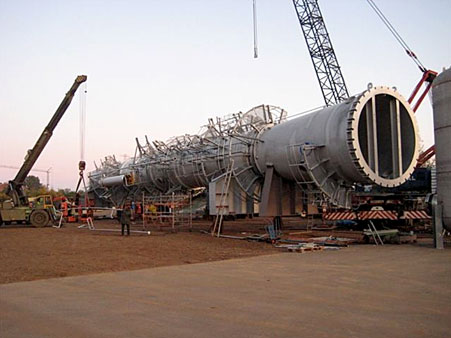
Metallisation customer, Iris NV, based in Belgium, has expanded its use of metal spraying and purchased additional Metallisation equipment to accommodate this expansion. Iris was founded in 1946 as an industrial painting company specialising in the treatment of gas pipes, electrical stations, high tension networks and power pylons.
The services offered by Iris became very popular, very quickly, throughout Belgium and it responded by expanding its services to include the protection of bridges and train stations. The company has continued to develop over the years and, in the late 1990s, built a brand new workshop measuring 100m x 20m, to enable the company to handle structures weighing up to 35 tonnes and measuring 35 square metres. Iris is now one of the leading companies in Belgium providing surface treatment, particularly anti-corrosion, to all types of structures.
Recently two of its most important clients, both in the petrochemical industry, requested metal spraying for a number of vessels and columns. Iris has been treating one of those clients’ pressure vessels, storage tanks and silos since 1964, so has an excellent understanding of the anti corrosion requirements. Metal spraying was the natural development for the protection of these vessels and tanks, as it’s proven to be a very robust coating solution for protecting against corrosion under insulation (CUI) of refinery / process plant vessels and steel fabrications. Both Shell and Exxon Mobil have embraced this process for the protection of steelwork against CUI applications.
As a result of the increased demands by many of its clients Iris decided, under the guidance of the workshop foreman, to teach more of its operators how to metal spray. The additional operators underwent an intense training course and completed the necessary qualifications to become proficient metal sprayers. This was critical to the client’s demands and specifications. It also ensured more members of the team now meet all of the industry standards and have an excellent understanding of all aspects of metal spraying.
Prior to spraying the distillation columns, for one of its petrochemical clients, the surface was prepared by grit blasting with steel grit to SA 2.5, with a surface roughness between 75µm and 110µm. This was then arc sprayed with aluminium Grade 1350 to a thickness of 250µm. A seal coat was then applied to the columns with Sigmatherm paint to a thickness of 25µm.
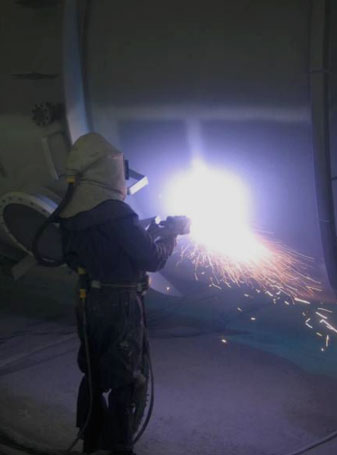
To meet this high demand Iris is now experiencing from its clients’, the company has purchased an additional system, to add to the five Metallisation systems it already uses. The system, the Metallisation Arc140/S350-CL (superseded model), will be located in the workshop where two existing systems are in constant use. The other four machines are frequently used on the job. In the field Iris also uses the wire flame spray equipment. By investing in this extra, state of the art, metal spray equipment the company can now specialise even more in this technique. By specialising in metal spraying Iris is able to treat all kinds of materials under different, more complicated circumstances. Iris believes in and trusts these long standing techniques, such as aluminium metal spray (TSA), and is happy that this will ensure its leading position in the industrial painting industry.
This article was published on the Offshore Technology website and is Available Here.
Chemical Vessels – Aluminium Sprayed – No Deterioration Detected
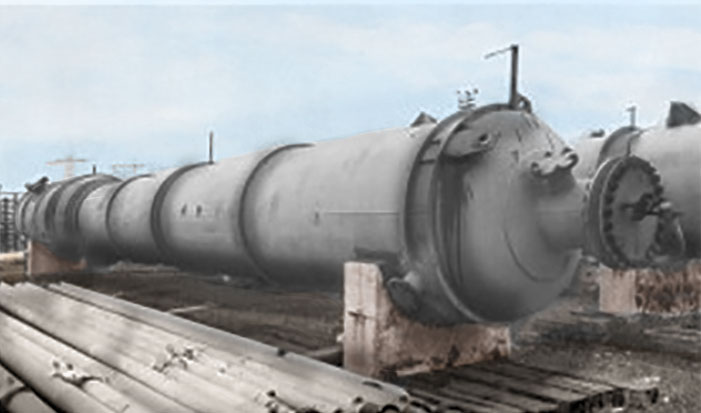
Very often due to changes in industrial policy or for other reasons, fabrications remain in a stored condition in the open air and lengthy periods of storage can sometimes cause damage by corrosive attack. The mild steel vessels shown in the photograph, which weigh up to forty tones were treated in 1972 and stored in the open for a number of years in a heavily polluted chemical atmosphere. An inspection has shown no sign of deterioration in the structure which has been grit blasted to S.A.3 and then aluminium metal sprayed to 125 microns (0.005”) nominal thickness, followed by an appropriate sealing process.
Corrosion Under Insulation is a major concern for Asset Managers as the corrosion eats through the piping unseen to the human eye, as it is covered by insulating material, the results of which can be major damage.
Long term accelerated corrosion caused by wet insulation occurs between -4oC and 150oC. Corrosion rates are variable but can be as much as 1mm per year.
This video provides an example of using Flame Spray as a solution in the Petrochemical industry.
Components for mud pumps – notable wear improvements are realized through corrosion seal treatments and the HVOF process.
This video is a Kermetico informational video on the several HVAF and HVAF/HVOF convertible metal spray systems, including the Internal Diameter Rotating gun.
This video features the major parts of the job featured in this case study including:
- The Channel Setup.
- Grit Blasting the Channel, using the Kermetico AK-07 HVAF gun.
- HVAF Spraying Hasteloy C-276 on the sections.
For more information on Metal Spray equipment or consumables, call us on 07 3823 1004, or email us using our contact form.