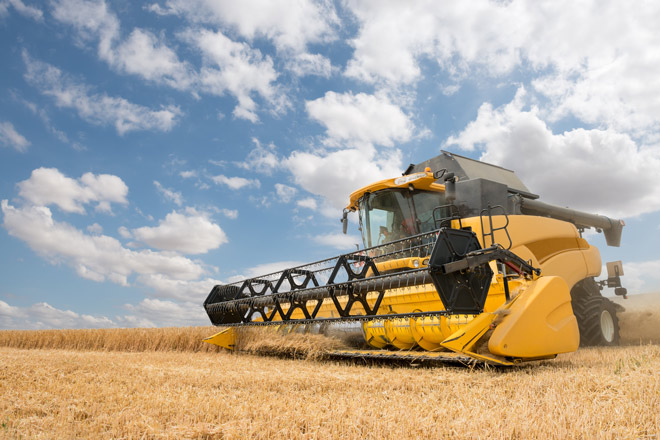
Metal Spray coatings engage growth in Agricultural applications. The necessity for cutting/slashing and ploughing means that the components used are subject to very abrasive and corrosive conditions. Metal/thermal spray coatings and hard-facing can provide the solution for wear and corrosion resistance, as well as extended life and increased performance. The necessity for the irrigation of planted crops requires pumps that will withstand the hardness and PH values of the water and fertilizers. Sugar cane crushers and sugar cane cutters also benefit from the Metal Spray process.
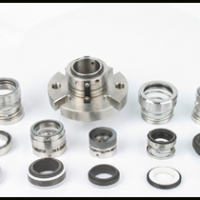
The Metal Spray Process Can Apply Ceramics to Pump Seal Areas to Repair and Protect OEM Components Including:
- Knives and blades.
- Threshing components.
- Ground engaging machinery.
Agricultural and Forestry Equipment can be Protected by Metal Spray Coatings Including:
- Barking blades & tools.
- Wear parts for farming tools.
- Feeding screws for fertilizers, and wood bark.
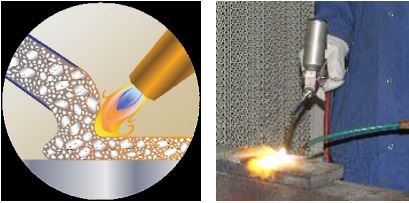
The metal spray and hard-facing processes use various forms of equipment that employ wire, powder and cord to deliver the required solutions.
Each Instance of Abrasion Doesn’t Have the Same Solution and Requires a Careful Study of Each Application According to:
- Type and size of the abrasive material.
- Abrasion rate, temperature, impact occurrence.
- Geometry, size and the weld ability of the part.
TufCote® “rope like” hard-facing electrodes to improve abrasion and erosion resistance.
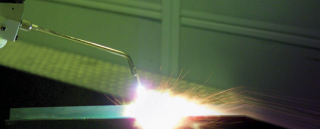
TufCote® is brazed using an oxygen-acetylene torch It can be weld on mild steel, low carbon steel, low alloyed steel, stainless steel, lamellar grey cast iron, spheroid cast iron. It can also be brazed on certain alloys of manganese steel with precautions. TufCote® is weld-able on itself, making local repair or recycling of parts possible.
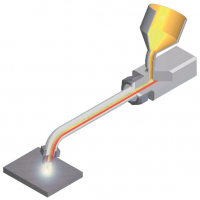
The powder welding process utilises an oxy-acetylene flame which is ideal for the deposition of smooth, thin, well bonded layers on a wide range of substrates, including cast iron. The hard-facing takes place at lower temperatures, which minimises oxidation and distortion of the work-piece and enables easy surfacing of edges.
Sugar Cane Cutters

Industry: Sugar Cane Production
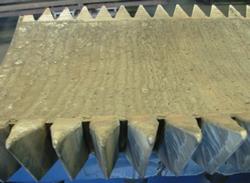
Problem: During operation the cutter teeth are subject to severe abrasion as a result of the dry fibrous materials extracted from the cane sugar and also from abrasive sands. Medium load impact can also occur during operation. Once the harvesting period begins, the equipment cannot be stopped for maintenance, which emphasises the need for reliable equipment during the large period.
Equipment Concerned: Teeth of Cutters
Service Conditions:
- Ambient temperature ~20°C to 50°C.
- Medium corrosion environment.
- Risk of medium shocks.
Caution: Usually, the cutters are manufactured from high tensile strength alloys. Make sure that the alloy to be coated can be hard faced. If the base material to be coated is not compatible with a hard-facing operation, flaking off and excessive cracking can occur.
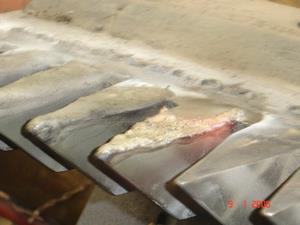
Coating Solution: Use specifically the TufCote® GN 6.35mm ⌀ or GM 6.35mm ⌀. Thickness 3 to 5mm.
Benefits of the TufCote®:
- TufCote® brazing alloy extends 2 to 3 times the life.
- The extension of the life-time allows to make more campaigns of production.
- Risk of medium shocks.
- Simplicity, easy learning of the brazing procedure, make it a possible application on site or in job shop.
- No capital investment is required to apply the TufCote® brazing flexible cord (only a flame torch is required).
- TufCote® can be applied on construction steel (the hard steels, or special and expensive steels are not required). Cutters could be made from relatively cheap steels.
- Possibility to rebuilt TufCote® on a cutter previously hard-faced.
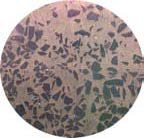
- Coarse and angular tungsten carbide grains, for better resistance to abrasion and a better anchorage of the carbides.
Other Solutions
Contact MSSA for more coating solutions with stick welding electrodes.
Sugar Cane Shredder
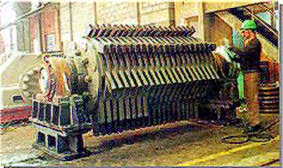
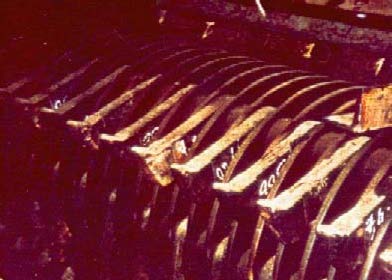
Industry: Sugar Cane Production – after harvesting, the cane sugar is transported to the mill where the cane billets are reduced by the shredder machines into fibrous materials. Then the sugar juice is removed by the extraction station.
Problem: During the smashing, shredder hammers are subject to severe abrasion as a result of the dry fibrous materials extracted from the cane sugar. Usually the shredder machine hammers are manufactured from Ni-Hard cast iron and could be designed with removable tips. Once the harvesting period begins, the shredder can not be stopped for maintenance, emphasising the requirement for the equipment to be reliable during the whole season.
Service Conditions:
- Ambient temperature ~20°C to 50°C.
- Medium corrosion environment.
- High rotating speed, risk of medium shocks.
Caution: Usually, the shredder machine hammers are manufactured from Ni-Hard cast iron. Due to the low thermal expansion coefficient, the Ni-Hard cast Iron cannot be directly brazed thanks to the TufCote®. Intermediate removable supports (such as patches) are manufactured and then brazed with the TufCote®. After brazing the support are fitted back on the shredder.
Coating Solution: TufCote® Abrasion-Resistant Coating: Tungsten carbide with a metal matrix; 5 mm thickness. Use specifically the TufCote® Grade A 8mm ⌀ (even 6.35mm).
Benefits of the TufCote®:
- TufCote® brazing alloy extends the life time 3 times more than Ni-Hard cast iron.
- The extension of the life-time allows to make 2 campaigns (could be extended to 3 campaigns).
- Due to the fact that, TufCote® is brazed on removable patches, the hard facing operation of the shredder is an unlimited renewable operation.
- Simplicity, easy learning of the brazing procedure make it a possible application on site or in job shop.
- TufCote® can be applied on construction steel (the hard steels, or special and expensive steels are not required). Cutters could be made from relatively cheap steels.
- No capital investment is required to apply the TufCote® brazing flexible cord (only a flame torch is required).
- TufCote® can be applied on construction steel (the hard steels, or special and expensive steels are not required) = shredder patches could be made from basic steels.
- Possibility to rebuilt on a coating previously welded.
- Coarse and angular tungsten carbide grains, for better resistance to abrasion (TufCote® Grade A).
- A metal wire is inserted inside the cord and avoids “butt”.
TufCote® GRADE A Product Specification
- Self Fluxing Alloy Matrix: 37 to 40% in weight.
- Tungsten Carbides: 60 to 63% in weight .
- Particle Size: Grade A within 0.1 to 1.6mm (10–150 mesh).
- Packaging: TufCote® is supplied as a continuous flexible cord, length depending on diameter and included in a protective plastic box. Available in 4.75mm or 6.35mm or 8mm ⌀.
TufCote® Application Procedure
Preparation of the Piece
- Surface must be cleaned and free of surface contamination.
- All edges must be cut by grinding.
Preheating of the Area
- With oxy-acetylene torch, preheat the piece area to 450°C (840°F).
Prime Cote (if required)
When welding stainless steel with TufCote®, an under layer might be applied about 300µm thick on surface before apply TufCote®:
- To avoid any oxidation of surface
- To prevent chromium migration to the surface (black bulk)
- To increase TufCote® bonding.
Hard-facing Operation with TufCote®

- The torch flame must form an angle of about 45° with the piece surface to be hard-faced, and TufCote® at a 45° angle to the same surface.
- The flame must swing from side to side of the weld deposit.
- TufCote® is then fed through the holder 4-6” at a time.
- The tip of the cord should not be lowered or lifted during the fusion process.
- The maximum speed of deposition is about 2Kg/hour (4.2 lbs/hour).
Animal Transport Vehicles
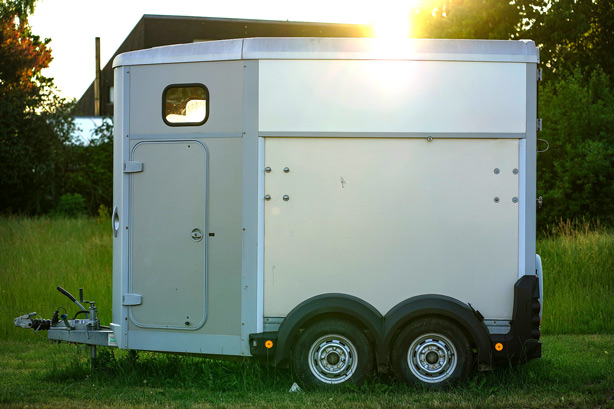
An application where the Metal Spray process has a significant advantage over Paint and Galvanising in regards to animal transport vehicles and trailers. Not only does the surface have to be able to withstand wear from the animal hooves etc. (which may contain erosive soil), but also the chemical effect of their urine and excrement. The use of Zinc in this application works within a pH range of 6 to 10. The urinary pH range for the cow, sheep, goat, and horse is ∼7.9 ± 0.5. For the pig, this range may extend to 6.5 ± 1.5, for cats and dogs 6.0 ± 1.0, and for humans 6.5 ± 1.5 (1). The diet of the animal is the major determinant of urinary pH levels.
Augers and Screws
HVAF and HVOF Thick Wear Resistant WC-Co-Cr Coatings for Augers and Screws
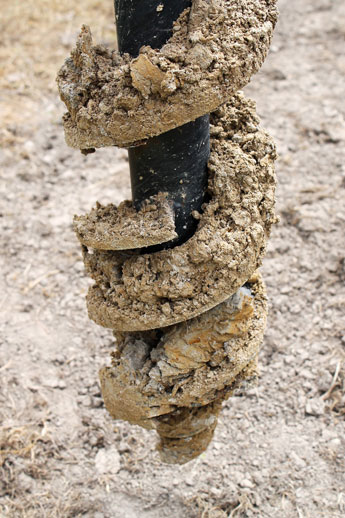
Kermetico HVAF equipment provides an effective way to protect augers and screws from corrosion and abrasive wear. Kermetico HVAF thermal spray systems deposit ductile, high-bond, thick tungsten carbide coatings harder than 1,600 HV300. The gas impermeable HVAF screw coatings are superior to any other thermal spray technology in wear protection of injection and extrusion screws and transport augers.
The Abrasive Wear of Screws and Augers
Transport screws are efficient systems for material handling. In addition to conveying of solid, semi-solid, wet and sticky materials, they are also used in production processes for drying, cooling and mixing. These processes cause extensive wear damage to the screw/auger flights and shafts.
Unprotected equipment could fail, causing a loss in productivity and expensive repairs.
Abrasive wear is probably the most common type of wear in the plasticating unit. If abrasion is allowed to continue unchecked, it will result in a gradual decrease in machine performance and, eventually, complete failure. In abrasive wear, the most common culprits are the fillers and additives in the resin.
Corrosion attacks the metal surface even when the machine is not in operation.
It breaks down the metal surface and renders it more susceptible to mechanical wear. Resins that have chlorinated and fluorinated components, such as PVC and PTFE, are very corrosive. Even a material that normally is not corrosive by nature can degrade under inappropriate screw design and a corrosive environment.
The best defense against corrosion and wear is the proper component material selection and the use of wear and corrosion resistant coatings.
A Surface Treatment to Protect a Screw from Corrosion and Wear
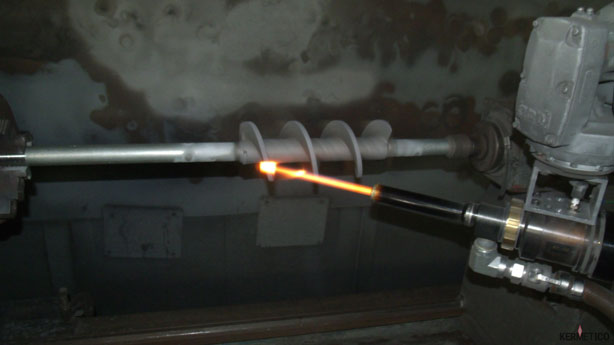
Carbide coatings deposited by using different high velocity technologies (HVOF, HVAF and Detonation), are extremely wear-resistant. The industry uses tungsten carbides in combination with cobalt, nickel or cobalt-chrome matrixes preferably. The erosion and corrosion behavior of thermal spray coatings is a major factor for the assessment of the coating application.
Kermetico HVAF equipment is used to deposit tungsten carbide coatings that are wear-resistant and tough enough to be used at all angles of impingement.
We recommend WC-CoCr-bound powders because they exhibit the highest wear resistance coupled with an adequate corrosion resistance in any environment except very high pH environments or hydrofluoric acid. Even 100 microns (0.004″) of our WCCoCr coating is gas-tight, protecting a base metal of a screw from corrosive agents as a barrier coating.
Since 2006 numerous different screws and augers have been sprayed for both new and repair work in our job shop, and Kermetico have never seen them again. They are still in service.
Blast and Spray Augers and Screws with Kermetico High Velocity Equipment
Usually, auger coatings are deposited using robotic blast and spray operations. Kermetico blast an auger surface with a Kermetico HVAF gun (it is extremely fast and uniform) and spray with the same gun after switching the powder feed hose and perhaps changing the nozzle. It is much faster, more accurate and consumes much less grit than conventional air blasting. Hot grit blasting provides very even surface preparation and induces less stress into the base metal.
For more information, Click Here.
Powder Welding on Pumps
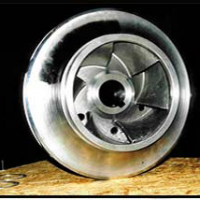
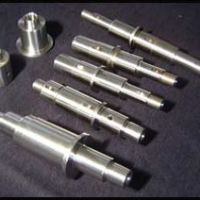
The application of Chrome Oxide ceramic powder or cord allows various pump parts to be either repaired or have their life expectancy increased with a very hard wearing coating.
Powder Welding involves an oxy-acetylene flame spraying followed by Fusing as a two stage process. After spraying, the coating is fused with an oxy-acetylene burner or for mass production. By using induction heating or a vacuum furnace, it allows the coating to be metallurgically bonded, extremely hard, corrosion resistant and resistant to impact and chipping. The powders used for Spray and Fuse hard-facing are typically compositions of Ni, Cr, Co, Bo, Fe, W and WC in varying blends.
Pumps can also be coated with Monel®, Inconel®, Stainless Steels by Flame Spray and Arc Spray methods. With Australia looking to be the market garden of the world, the Metal Spray and hard-facing processes will be playing a large part in its success.
|
Mechanical Seals |
Pump Impellor |
Pump Shafts |
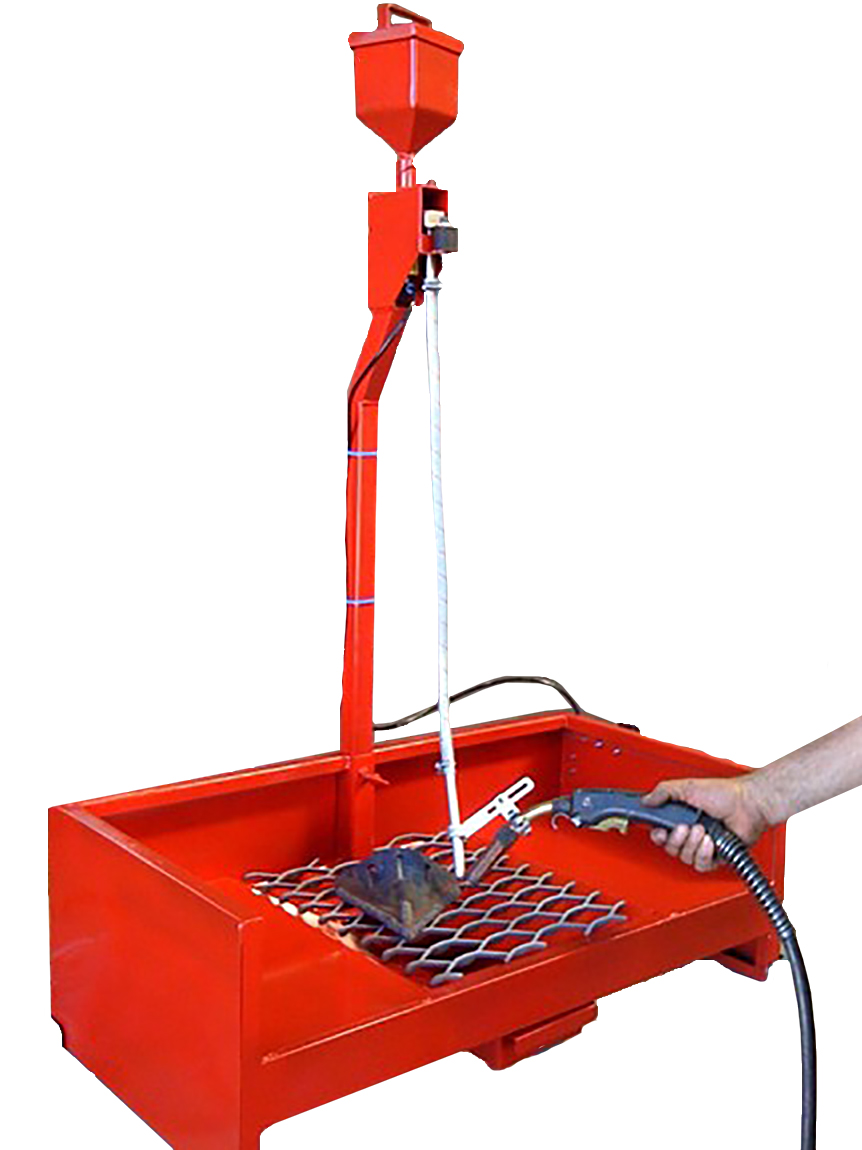
The MSSA Tungsten Feeders (also known as a Pneumatic Tungsten Grit Feeder) are used for Tungsten Hard Facing with Tungsten Carbide. An air driven vibrator consistently feeds the tungsten fragments to your MIG torch. As it is pneumatically powered, there are no electrical components, this adds to our Tungsten applicator’s superior reliability when compared with other feeders on the market. To ensure air supply is constant, the feeder has a special fine tuning control after the air gauge to make sure the air pressure to vibrator is maintained.
 |
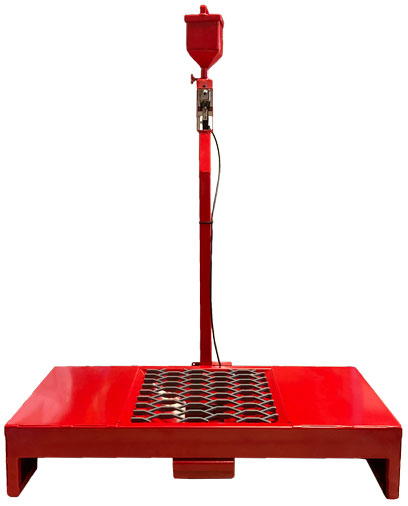 |
| Tungsten Feeder | Tungsten Feeder (L) |
A tungsten grit application can prolong the life of a component by 3 to 5 times (depending on the application) which can make a substantial difference to running costs.
Ground-engaging equipment is commonly associated with the tungsten hard-facing process. Ground engaging blades and ripper points on dozers and cat trucks are just some of the numerous applications that this process is used on.

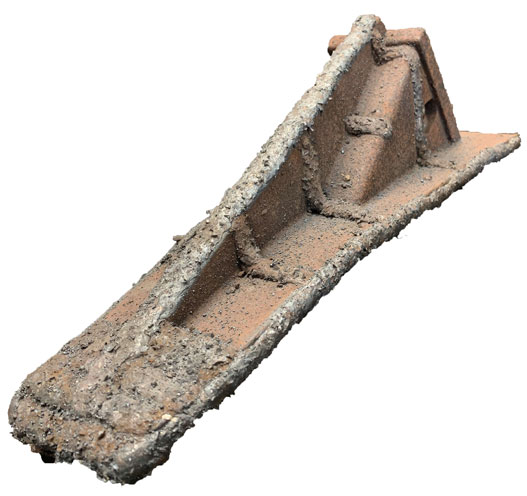
When painted components are subject to hard-facing, the application area is often grit-blasted initially in order to provide a better surface for the tungsten to bind to.
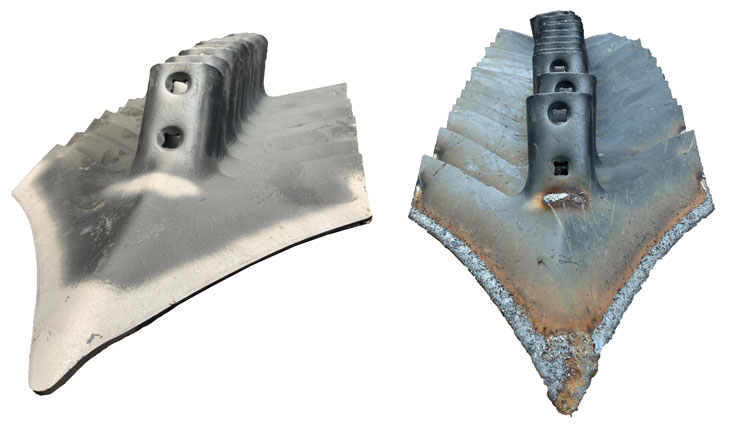
Ground Engaging Blades Grit-Blasted (Left), with Tungsten Application (Right)
Other Applications Include
- Augers.
- Bed shapers.
- Chisel plow points.
- Ditch and trencher teeth.
- Down the hole drilling equipment (DTH).
- Dozer buckets.
- Drill bits.
- Excavator tools.
- Grader and scraper blades.
- Mining picks.
- Mower skids.
- Plough shears.
- Scarifier points.
- Shredder hammers.
- Slurry agitators.
- Slurry paddles.
- Toolbar shanks.
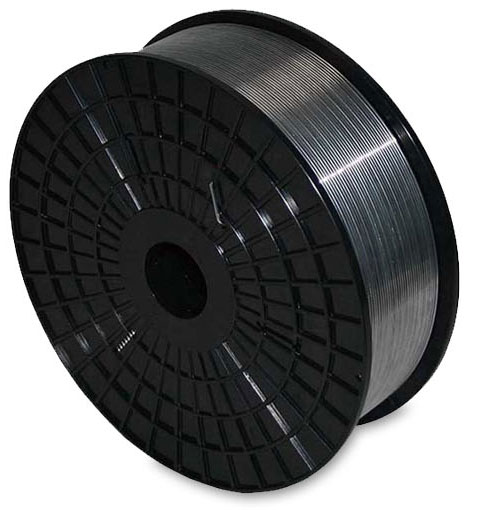
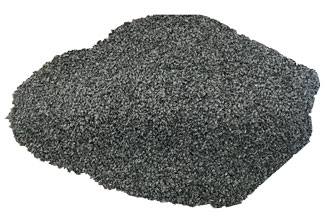
We also supply the hard-facing wire and tungsten grit to suit your application.
For more information on the MSSA tungsten feeder, Click Here.
Livestock Trucks
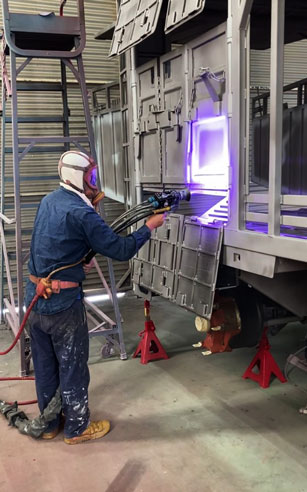
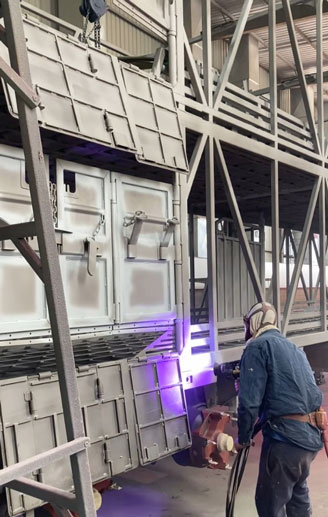
Livestock/Cattle trucks use the Arc Spray process to protect them from corrosion.
For more information on Metal Spray equipment or consumables, call us on 07 3823 1004, or email us using our contact form.