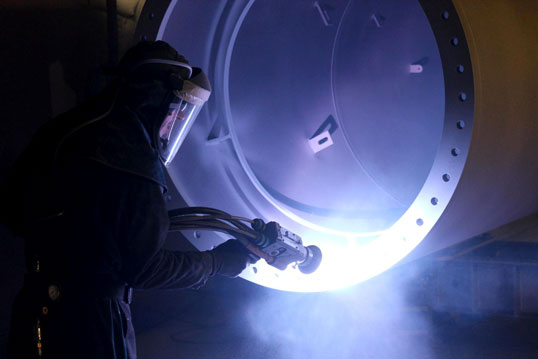
Large-scale use of biomass, recycled fuel, solar, wind or Hydro power is increasing in energy production due to climate and energy targets. For these critical applications it is extremely important to mitigate corrosion and wear.
Biomass Combustion
Unfortunately the Biomass combustion is detrimental to components of the power plants due to very reactive elements such as chlorine and heavy metals that cause slagging and high temperature corrosion.
Hydropower & Wave
In addition to the general erosion and abrasive wear, renewable energy components for wind & tidal systems are subjected to high levels of corrosion caused by acidic or alkaline water conditions
Wind
The use of Zn, Al & Zn-Al to structural steel Monopiles and jackets, are utilised in an effort to protect these structures from the effects of corrosion, with Al extremely effective to salt water corrosion.
Tidal
The mechanical components from the technologies used to convert tidal energy are consistently subjected to combined corrosive-erosive wear.
Solar
The equipment in the solar industry is subject to damage and corrosion due to the harsh environment they are situated in.
The use of ARC Spray, Flame Spray, HVOF or Plasma spray all play their part in the process to extend the life of these industries, whilst providing significant savings by reducing downtime for costly repairs. The Metal Spraying process can be completed both manually and automatically.
Steam and Land-Based Turbines
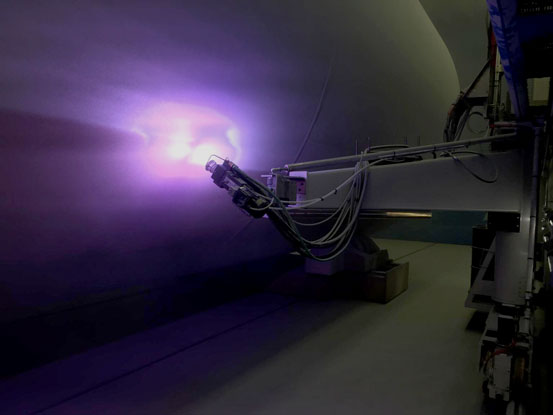
Steam and land-based turbines owe their operating efficiency to Metal/Thermal Spray. The video below shows a HVAF system spraying a WC-Co-Cr coating being applied on-site onto steam turbine blades in order to protect them from droplet erosion.
Almost every component of the gas turbine engine has some type of coating on it to prevent the damage caused by wear and temperature. HVAF and HVOF coatings are used in the hot section of the engine to coat the shroud with high temperature metals that will not damage the edge of the engine’s turbine blades, yet provide the tight clearance necessary for the engine to function properly. HVAF and HVOF coatings are also applied to the rotating sleeves or bearing found in the hot section of the engine. Common coatings used in this application include T-800 and Chromium Carbide Nickel Chrome coatings.
Wind Turbines
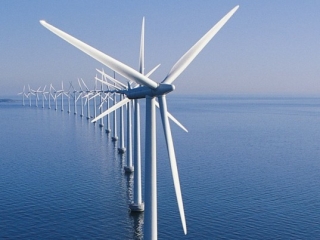
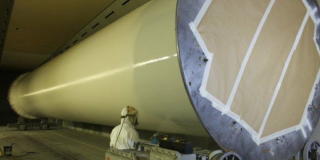
Wind Turbines can be subject to harsh salt water environments sometimes installed out at sea or on the shore line a protective coating of Zinc or Aluminium or an alloy of the both gives the corrosion resistance vital to its survival. Arc Spray systems manually and automatically apply corrosion protection coatings to wind turbine towers and components on land and sea.
The above video shows the zinc Arc spray coating process of wind towers (turbines) from blast, thermal spray zinc, prime and top coat.
Pelton Buckets
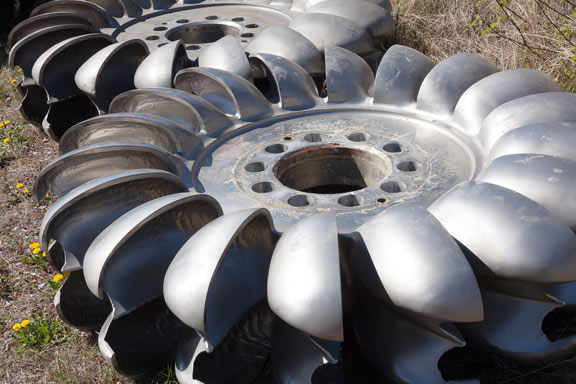
Pelton Buckets suffer high wear on the internal surface due to silt erosion and cracking on the thinner bucket surface areas cause an imbalance in operation. These are protected by HVOF Spraying or Arc Spraying with 420 Stainless Steel.
Wear Protection of Turbine Rotors with HVAF and HVOF
Kermetico HVAF technology and equipment allows the deposition of impermeable, hard and ductile coatings to protect turbine rotors from corrosion and wear.
The high ductility of our rotor coating reduces the risk of cracking if flexed and provides loading stress resistance, while the gas-tight structure provides corrosion resistance.
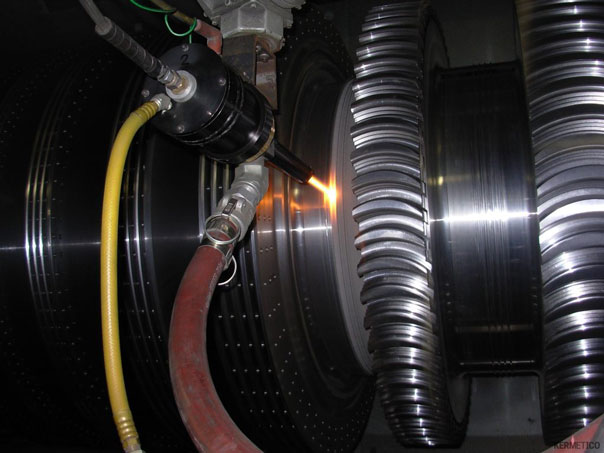
The HVAF Coating of a Geothermal Rotor after Solvent Cleaning
The Wear and Corrosion Factors of Turbomachinery Rotors
Pitting Corrosion of Steam Turbine Rotors
Pitting, corrosion fatigue and stress corrosion cracking problems all occur in steam turbines. The primary corrodents are sodium hydroxide, chloride, sulfates and sulfides.
Usually, the level of contaminants present in steam is not high enough to corrode the system components. As steam expands through a turbine, the solubility of contaminants in the steam decreases. They condense onto surfaces at solution concentrations much higher than the original contaminant level in the steam. These concentrated solutions promote system corrosion.
Rotor pitting corrosion is commonly associated with chloride deposits.
Flow-Accelerated Corrosion of Steam Turbine Rotors
Flow-accelerated corrosion of carbon and low-alloy steels in the steam path two-phase flow has been less widespread in fossil plants than in nuclear plants; however, it has occurred in some locations, like rotor seal areas and rotor shaft-last disk transitions.
Geothermal Turbines Corrosion
The geothermal corrosive environment determines the choice of highly corrosion-resistant materials for rotors and blades. Different rotor and blade materials frequently result in electrochemical corrosion.
Due to the galvanic corrosion effect, rotor materials were subjected to more severe crevice corrosion than blade materials. The stress corrosion cracking initiation and propagation did not occur after 4,000 hours of corrosion testing in H2S free waters, although the sulfide induced stress corrosion cracking took place in water with hydrogen sulfide.
Those are the reasons why different techniques of surface treatment are being used to protect turbine rotor surfaces.
The Features of Kermetico HVAF Coating Technology
Kermetico High Velocity Air Fuel (HVAF) technology has been shown to be very competitive in the protection of turbine rotors from corrosion and wear.
Thicker layer HVAF rotor coatings provide an option to refurbish even heavily worn rotors.
The high velocity of the Kermetico HVAF in-flight particles (over 1,000 m/s) enables the production of very dense coatings with high adhesion.
Moreover, the low combustion spraying temperature (1,960-2,010°C | 3,560-3,650°F) and gentle particle heating lead to minimal feedstock phase transformation and almost nonexistent elemental depletion/decomposition of the in-flight particles.
Furthermore, the replacement of pure oxygen necessary for HVOF with air in our HVAF process significantly reduces the oxide content of our coatings, which is desirable for high-performance coatings.
The Kermetico HVAF Rotor Coating Method
The traditional thermal spray approach is to melt and atomize the feedstock, propel it to the surface of the target part whereupon contact ‘splat cooling’ builds up a coating.
The Kermetico HVAF process operates on a different principle “heat slowly, spray faster.“
We heat the feedstock material to near its liquid phase temperature without exceeding it.
Then we accelerate the particles to an optimized high velocity, and when the particles impact the substrate, there is a rapid conversion of kinetic to thermal energy that allows for plastic deformation of the particle and a bond that we cannot accurately measure.
In the ASTM 633C bond test, the only result we get is broken glue at 12 KSI, even with 0.040“ (1 mm) of WCCo 88/12.
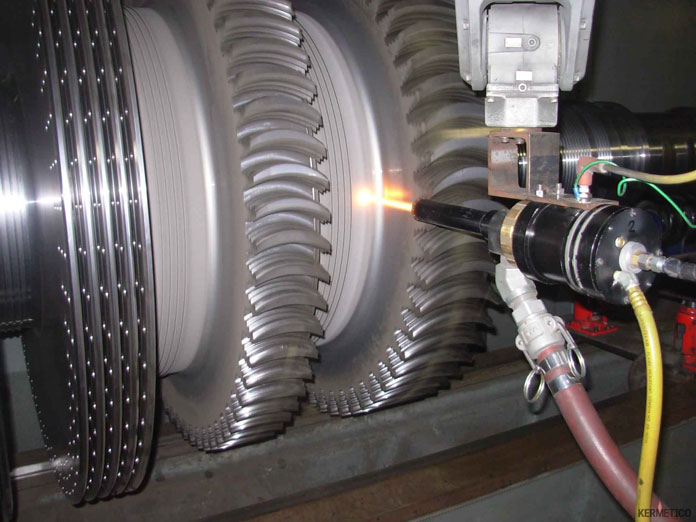
Kermetico HVAF AK7 System Depositing a Coating onto Labyrinth Seals of a Geothermal Turbine Rotor
Erosion Protection of Compressor and Steam Turbine Blades with HVAF and HVOF
Kermetico HVAF technology and equipment allow the deposition of impermeable, hard and ductile coatings to protect steam turbine blades from water droplet erosion.
The high hardness and high ductility of our bulk-like coatings reduce the erosion rate substantially and provide loading stress resistance, while the gas-tight structure provides corrosion resistance.
Kermetico air-cooled equipment is easy to transport and use on-site both in robotic and handheld operation.
Our coatings provide a better quality/price ratio for steam turbine blades protection than most other coatings, heat treatment or implantation methods.
The Erosion of Turbine and Compressor Blades
Water Droplet Erosion of Steam Turbine Blades
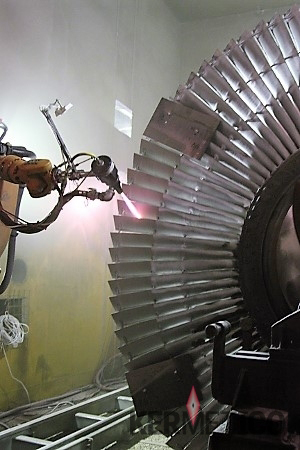
Water droplet erosion of steam turbines happens due to the impingement of water droplets of several hundred microns to a few millimeters size at velocities of hundreds of meters per second on the edges and surfaces of low-pressure steam turbine blades.
The Liquid Impingement Erosion of Compressor Blades
In the power generation industry, inlet fog cooling is used frequently to cool down the turbine intake air. Gas turbine inlet air fog cooling is the most direct, cost-effective, and energy-efficient solution for increasing the power output of gas turbines. It is performed by spraying water into the gas turbine inlet.
This approach results in liquid impingement erosion of the rotating blades in the compressor, performance degradation and service life reduction of gas turbines. Liquid impingement erosion is defined as the continuous material loss from a solid surface due to the repeated impacts of liquid drops or jets.
The solution to these problems is in high demand especially due to the high replacement cost of the blades of gas turbines’ compressors and those operating at the low-pressure (LP) end of steam turbines.
Surface engineering substantially improves erosion resistance of turbine and compressor blades. There are a variety of protection methods, including heat treatment, hard-facing, laser cladding and thermal spraying. HVOF tungsten carbide, chromium carbide and Stellite-type coatings have been chosen among the best thermal spray candidates, while laser cladding of a Stellite-type coating has been a winning metallurgical approach.
The Advantages and Disadvantages of Different Surface Engineering Methods for Mitigating Water Droplet Erosion
| Method | Water Droplet Resistance | Technological Risk | Necessity of Post-Treatment | Cost |
| Heat treatment | Lowest | Part Geometry Distortion | No | Lowest |
| Laser Clad Stellite | Moderate | Part Geometry Distortion | Yes | Highest |
| HVOF Stellite | Moderate | No | No | High |
| HVOF Cemented Carbides | High | Cracking | No | High |
| HVAF Tungsten Carbide | Highest | No | No | Moderate |
Recent developments in HVAF technology have made Ultra-quality Kermetico HVAF WCCoCr coatings the best choice to resist water droplet erosion.
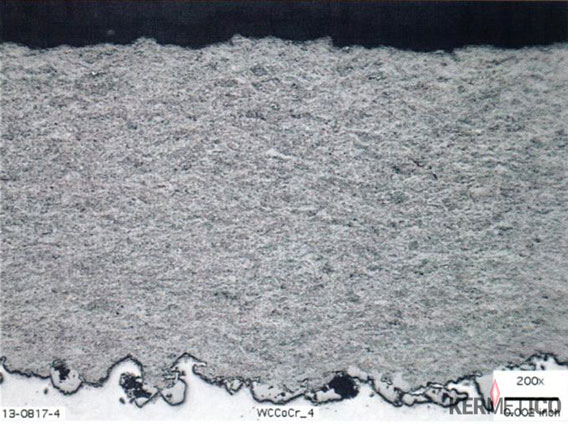
A Micrograph of a HVAF C6 System in U-mode Using Propylene Gas to Spray a Tungsten Carbide Coating: No Gas Permeability at 300 PSI, Hardness 1,650 HV300
Wind Turbine Tower Protection
Zinc Coating Protects the Next Generation of Wind Turbine Towers
Reason for use: Wind turbine towers, like all steel structures which are located outside, can be prone to corrosion.
With the ever increasing demand for wind power, alongside the challenge of producing taller and taller wind turbines, Andresen Towers has developed a new type of wind turbine tower.
As with all steel structures which are located outside, corrosion is an issue which needs to be addressed. During the design stage of the tower systems, Andresen Towers reviewed a number of protective coatings and finally decided upon a coating of thermal sprayed zinc, applied with Metallisation ARC528 Arc Spray systems, and finished with a paint top coating. At the bolted flange areas of each tower panel the zinc coating is left unpainted. As well as offering excellent corrosion protection, the texture of the zinc spray aids in the strength of the bolted joint by increasing friction.
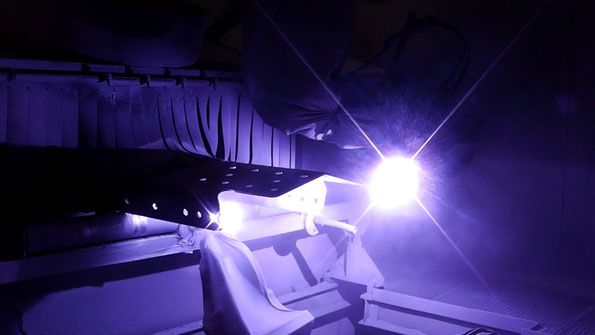
For land based towers, the ends and the flanges are all sprayed, including the internal and external flange areas. During the metal spraying process, the spray rate is varied, as some areas are specified as requiring a thicker coating than others. For on-shore towers, that will be located within 25km of the coast, the whole outside of the tower is metal sprayed.
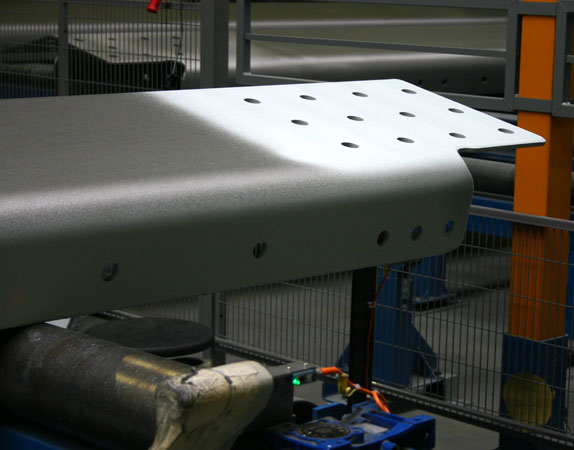
With huge demand for these towers and the large surface areas to be protected, it was immediately apparent that conventional manual thermal spray systems would not efficiently cope. It was also clear that standard automated systems would struggle to meet this demand. However, Metallisation’s proven ARC528E-ACD/S1500 Arc Spray systems, operating at up to 1500A offered the ideal solution.
Each tower section is made up of fourteen individual panels, which are then bolted together on site. The advantage is that the smaller, lighter wall sections can be easily transported into hard to access areas, such as forests, where a tall tower is required but access for transport is often limited.
Andresen Towers, a privately owned company based in Denmark, specialises in the development and production of bolted steel shell towers and is a customer of Metallisation distributor, Sonnimax.
Andresen Towers has purchased three Metallisation ARC528E/S1500 Arc Spray systems, which have been used to metal spray the wind turbine towers, in order to protect them from corrosion. The design and coating specification of the wind turbine towers is stringent and volumes are high, which is why the whole process has been fully automated for maximum efficiency.
Prior to the metal spraying process, the panels, manufactured at another Andresen Towers facility, are automatically prepared. The preparation process includes, inspection of the panels and de-greasing and shot blasting of the complete panel sections. The metal sprayed areas are also grit blasted to an SA3 specification, in a robotic blasting cell. Quality control checks are implemented at various stages of the preparation, as would be expected in a high class facility. The prepared panels are then automatically transferred, by conveyor, to the metal spray booth.
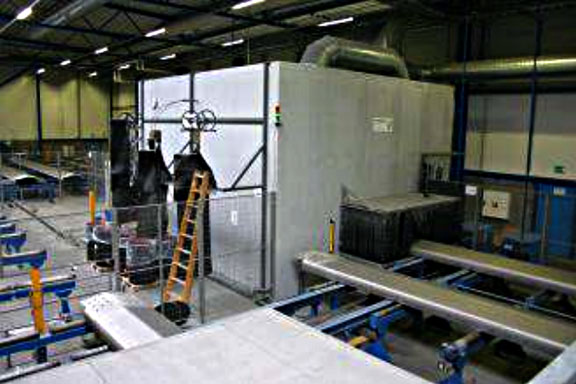
The fully automated metal spray facility is an acoustic booth containing two robots, one positioned above and one below each panel. One of the pistols has been modified from its standard configuration to enable better access. This ensures a high quality coating is applied to the underside of each panel. An electronically synchronised push/pull system is used under the panel, due to the longer reach demands of the robot. The 500kg zinc drums, which are located outside the booth, are supplied with leading / trailing edges exposed on the wire. This allows the operators to join the wire and maintain continuous production even when the drums run out and need to be changed.
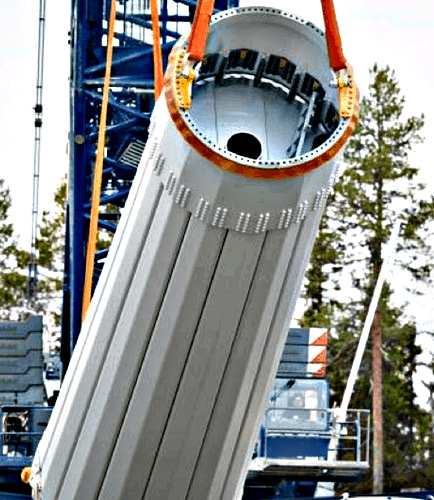
Mabey Bridge Wind Turbine Towers
Reason for use: Wind turbine towers are exposed to harsh external environments, particularly those in an offshore location.
Metallisation’s customer, Mabey Bridge, recently metal sprayed a number of Endurance Windpower X-Series wind towers, using the Arc Spray ARC140/S350-CL system (superseded model), to protect them from corrosion.
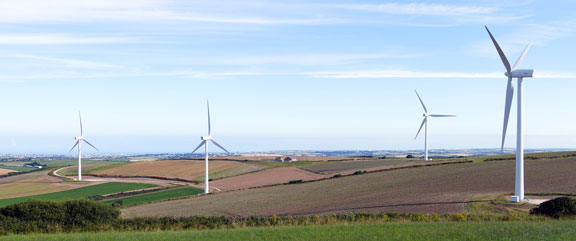
Mabey Bridge is a specialist supplier of high quality steel bridges, infrastructures, wind turbine towers and heavy plated structural steel work. Based in Chepstow, Mabey Bridge has extensive experience in the production of wind turbine towers, with a specialist factory designed to produce up to 150 towers per year. The company manufactures wind towers from flat sheet to final fit out at its Chepstow factory. The whole process from rolling, welding, coating and fitting out a tower takes around seven to ten days.
Wind turbine towers are exposed to harsh external environments, particularly those in an offshore location. Mabey Bridge is well-established in the wind energy market, serving several major manufacturers and increasing the number of UK-made components in wind energy installations.
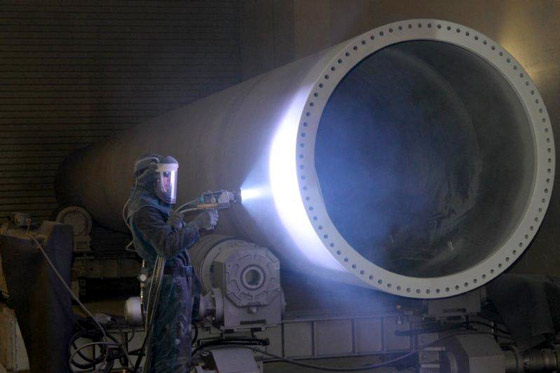
In this project, the 30 metre high X-Series wind towers have been metal sprayed on behalf of Endurance Wind Power. The metal spraying process used is a typical specification for this type of structure. The surface of the wind towers is prepared by blasting with a mix of GH25 and GH40 steel grit using a 12.5mm nozzle at nine bar pressure. The areas to be metal sprayed are grit blasted to standard SA3, while the areas that are painted, and not metal sprayed, are prepared to standard SA2.5. Mabey Bridge has a dedicated blast booth with programmable rotators, which provides a safe, clean and efficient area for the blasting process.
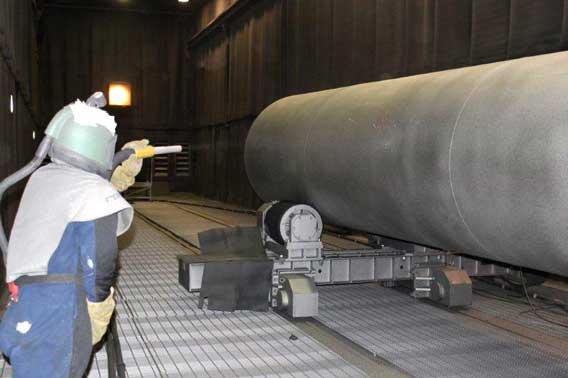
The blasted sections are then transferred on the blast rotators to the metal spray booth. The metal sprayed coating cures instantly so the tower sections can be rotated directly on the outside diameter. For a land based turbine, various areas are zinc coated with typically 60-120 microns of Zn, using the Metallisation ARC140/S350-CL twin wire arc system (superseded model). The metal sprayed zinc coating is applied to areas more susceptible to corrosion due to assembly damage and normal usage. Specifically, these areas include the studs, brackets, internal fixing areas, the connection flanges located at both ends, plus 300mm internally and externally from the flanged ends. The base section of the tower has an access door, where the internal and external surfaces of the tower are zinc metal sprayed to the top of the access hatch plus 300mm.
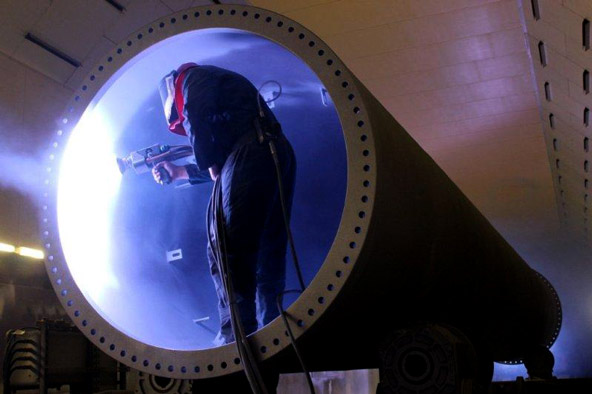
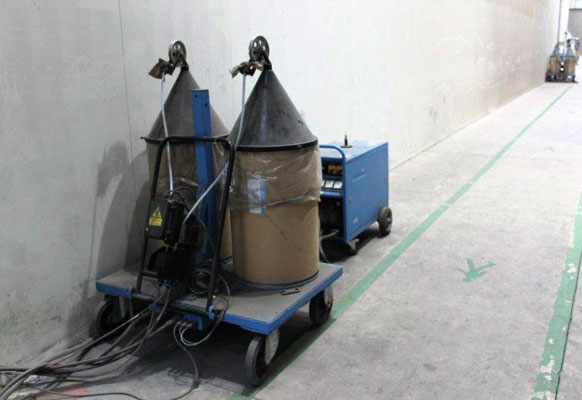
The Metallisation ARC140 system (superseded model) uses a synchronised push/pull wire feed arrangement to feed the zinc wire from the two, 250kg dispensing drums to the spray pistol. The synchronised feed system allows extremely reliable wire feed up to 20 metres from the pusher unit to the pistol. This enables Mabey Bridge to efficiently spray the inside and outside of their longest tower sections without having to move the heavy wire drums or power supply. They simply take the pistol and supplies package right up through the inside of the tower and can reach all areas from the ends of even their longest 36m tower section. The ability to have the power supply outside the dusty spraying area also improves reliability, efficiency and makes preventative maintenance a simpler and cleaner process.
After metal spraying is complete, the tower sections are transferred to dedicated paint spray booths. A typical paint specification would now see all areas of the tower section, except the flanges, being sprayed with around 50 microns dry film thickness (DFT) of a 2-component zinc rich epoxy primer coat. The flanges are left unpainted as the profile of the metal sprayed zinc aids the strength and friction of the bolted joints. There is an approximate curing time of two hours at 40 to 50°C. The mid-coat, commonly a 2-component high build epoxy, is then sprayed at around 120 microns DFT for the internal surfaces of the tower and 150 microns on the external surfaces.
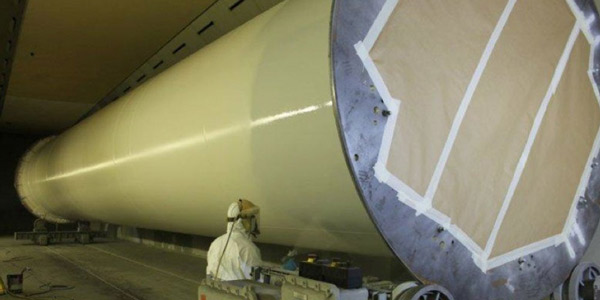
There is a further two hours curing time required at 40 to 50°C. The final top coat to be applied is around 50 microns DFT of 2-component gloss acrylic polyurethane to the external surfaces of the tower. There is approximately four hours curing time required at this stage, again at 40 to 50°C.
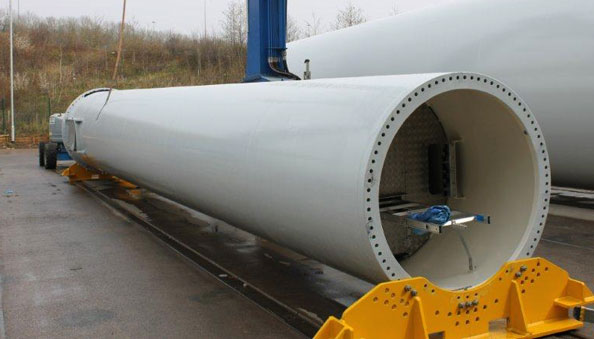
This specification of zinc metal spray and paint is quite typical for land based wind towers. Some other specifications call for more or all areas of the tower to be metal sprayed. Some tower users also specify zinc/aluminium alloy as a metal coating. Aluminium is also considered for off-shore towers, following the lead from the oil and gas industry. Other areas of the complete wind turbine are also metal sprayed including support steelwork, jackets, boat docks, nacelles and rotor hubs.
Metallisation is the only UK developer, manufacturer and worldwide supplier of metal spraying equipment and consumables. With extensive experience, knowledge and expertise, Metallisation provides a wide range of engineering coatings, as well as anti-corrosion solutions, to diverse industries on a global scale.
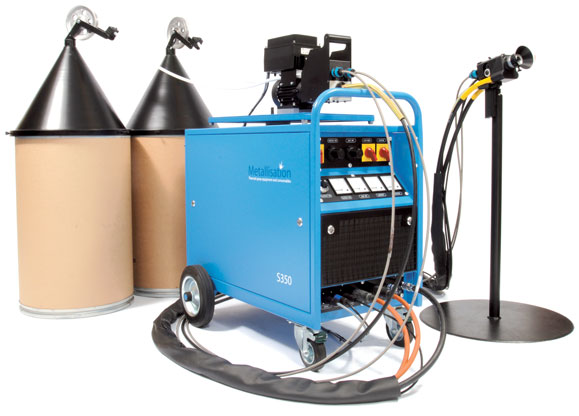
Metallisation Arc spray equipment is the ultimate solution to today’s demands for high performance coatings. The Metallisation ARC140/S350-CL (superseded model), used in this project, is a unique blend of ability and innovation. The recently updated system enables the operator to set the spray current independent of wire type before starting the job, enabling easier setup and protection of the system from over- current.
The control function is controlled by a simple PLC, which ensures improved reliability as less component parts are required. The efficiency and effectiveness of the ARC140 (superseded model), as well as the whole process from blasting through to metal spraying, can be seen in the video at the top of the page.
Due to the success of the new wind turbine facilities, Mabey Bridge has developed its services and is a recognised tubular products supplier. With the facilities, which opened in May 2011, they can produce and coat tubular sections from 500mm up to 4.8 metres in diameter and up to 36 metres long, with a wall thickness of up to 70mm. They produce tubular products for the civil engineering industry (such as dock monopiles), and the oil and gas industry (including monopiles, meteorological masts and drill conductors).
Erosion and Cavitation Resistant Coatings
Silt and Sand Erosion and Cavitation of Hydro Turbines and Impellers
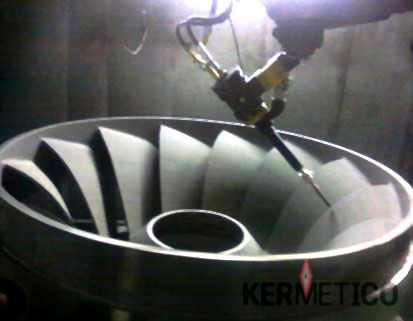
Cavitation is a phenomenon which manifests itself on the metallic surfaces of rotating parts. The mechanism of material damage during cavitation is mainly attributed to the implosion of high-velocity bubbles on the component surface leading to a local increase in stresses in excess of the yield strength of the material.
Silt or sand erosion is caused by the dynamic action of the silt or other particles flowing along with water, impacting against a solid surface of turbine vanes and blades. The erosion and abrasive wear not only reduce the efficiency and the life of the turbine, but also cause problems in operation and maintenance, which ultimately lead to economic losses. Researchers have found that cavitation in a particle flow is more severe than in pure water – meaning that the combined effect of silt erosion and cavitation is found to be more pronounced than their individual effects. The phenomenon of cavitation erosion gets aggravated under high turbulence conditions of fluid flow containing suspended particles.
The majority of particles encountered in hydro turbines are quartz, having a hardness of seven on the Mohs scale. Different types of hydro turbine equipment suffer from various factors: Francis wheels are subject to silt erosion and cavitation together, while Pelton and Kaplan turbines are subject to silt erosion and corrosion.
Kermetico HVAF equipment provides an effective way to protect impellers and hydro turbines from the harmful effects of cavitation and silt erosion.
Kermetico HVAF systems operate a range of thermal spray guns for coating outer diameters, internal surfaces, and manual spraying to deposit ductile, high-bond tungsten carbide coatings harder than 1,600 HV300.
For Hydro Turbine coatings, the Multi-Purpose HVAF AK Systems, AK6 (Larger Hydro Turbines) and AK5 (Smaller Hydro Turbines) are recommended.
Solar
Wind Power
Wind power is one of the fastest-growing renewable energy technologies. Global installed wind-generation capacity onshore and offshore has increased by a factor of almost 75 in the past two decades. However protection of these is paramount as they are subjected to the most aggressive environments. They are constantly exposed to humidity with high salinity and to intensive UV-radiation.
Thankfully TSZ/TSA wind towers provides the necessary protection which will remain effective during the designed 25–40 years’ lifetime of these wind farms.
The Wind towers sections are initially grit blasted to SA3 standard then the various areas are zinc coated with typically 60-120 microns of zinc or Zinc/aluminium. The Arc sprayed zinc coating is applied to the main tower sections and also areas that are more susceptible to corrosion due to assembly damage and normal usage. Specifically, these areas include the studs, brackets & connection flanges. For external corrosion protection of offshore monopiles the application of Arc sprayed Aluminium + sealer to just below the minimum sea water line to several meters below the sea bed is used .
This form of protection gives an impressive cost–benefit relationship.