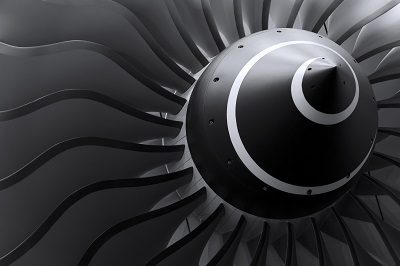
Did you know that without the Metal/Thermal Spray process you wouldn’t be flying at the speeds or distances we do now? Why? Because jet engines use over 100 applications for Metal/Thermal Spray coatings, most of which are to protect the components from heat. Coatings to resist heat involve various coating processes as well as various metals and ceramics.
Aviation
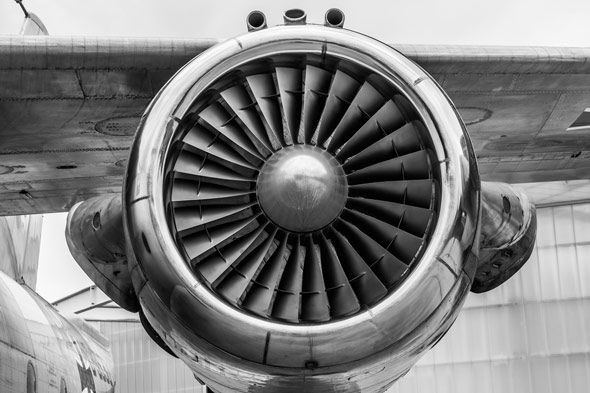
Modern aviation owes its success to the jet engine. The technology was originally developed in the late 1930’s and early 1940’s for military use in World War Two, but it has since powered the passenger aircraft revolution.
Space Travel

In space travel the liquid rocket engine components operating in cryogenic conditions are coated with Arc Sprayed Aluminium whereas the rocket exhaust cones are protected by plasma sprayed Zirconium Diboride.
Exhaust Gas Stacks
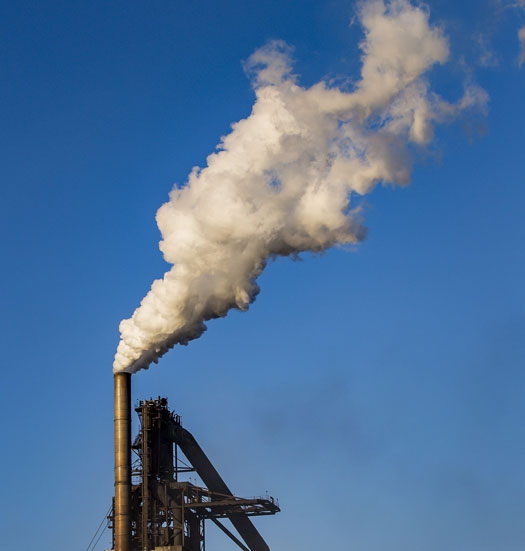
Exhaust gas stacks and industrial chimneys have to withstand effects of heat and corrosive gases in addition to the corrosion attack from the environment. This is catered for by the application of Arc Sprayed aluminium.
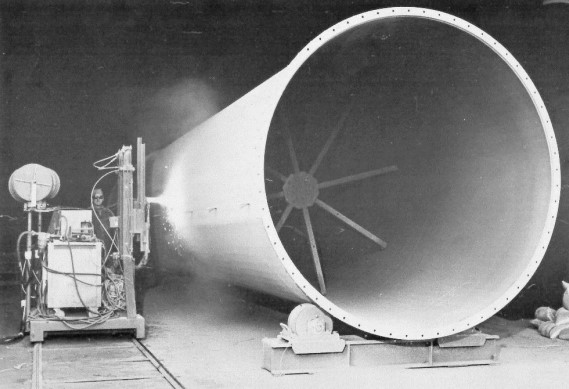
The above image shows a 2.74m (9ft) diameter, 16.46m (54ft) long section of an exhaust gas stack for Heysham Nuclear Power Station on the Lancashire Coast UK. This is one of fourteen sections making up the complete installation.
Automotive

High performance motor cars use metal sprayed ceramic coatings to provide a highly effective thermal barrier on exhausts, turbo’s and brake parts which enables high performance vehicles to run at cooler temperatures. The ceramic coatings work by preventing heat transfer, which means an increase in power and reduced heat input to other components. A typical drop of 25ºC in under bonnet temperature will result in decreased intake temperature, which can give up to a 5% increase in power and significantly increases ancillary reliability. The ceramic coatings can reduce surface temperatures by up to 160ºC and can withstand temperatures of up to 1400ºC. This compares with typical standard ceramic containing paint, which may only reduce surface temperatures by up to 9%.
The ceramic coating contains magnesia / zirconia and offers the best thermal barrier coating. The coating is creamy white in colour, with a slightly rough surface texture. There is an alternative darker plasma ceramic coating, which contains alumina/titania and has a grey coloured appearance.
Protection Against Thermal Shock
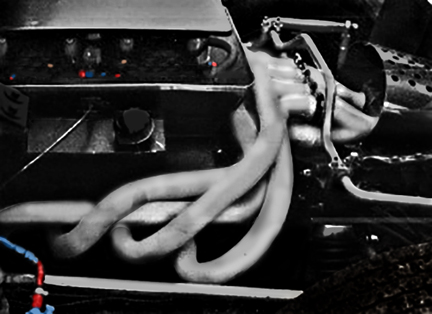
Heat resistant surfaces produced by the metal spraying process have many applications; the photograph shows a rather unusual variation of this theme. Two independent exhaust systems, fabricated from steel tube in the Ford GT.40 sports car, have been metal sprayed with 175 microns (0.007”) of aluminium using the Metallisation Fine spray electric arc techniques. The treatment has been found to be fully effective in overcoming the extremes of heat oxidation and thermal shock from the output of this high performance engine.
Engineering Production
Metallisation customer Woof Thermal Management Technology has applied well proven plasma ceramic coatings technology to high performance automotive applications, to provide highly effective thermal barriers in extreme conditions.
Woof Thermal Management Technology, based in Bradford, West Yorkshire, UK provides premium specialist coatings and engineering services to industry and end users. The plasma ceramic coatings range has been developed for the nuclear industry, but is proving itself to be very effective and valuable in heavy engineering, aerospace and motor sport industries.
Using Metallisation Plasma spraying equipment, Woof Thermal Management Technology has extensive experience in supplying premium thermal barrier coatings to the motor sport industry. Woof coatings have been specifically developed to reduce under bonnet temperatures, increase power output and increase the reliability and longevity of ancillary components.
The durable plasma ceramic coating provides a highly effective thermal barrier on exhausts, turbo’s and brake parts and enables high performance vehicles to run at cooler temperatures. The plasma ceramic coatings work by preventing heat transfer, which means an increase in power and reduced heat input to other components. A typical drop of 25ºC in under bonnet temperature will result in decreased intake temperature, which can give up to a 5% increase in power and significantly increases ancillary reliability.
The Woof plasma ceramic coatings can reduce surface temperatures by up to 160ºC and can withstand temperatures of up to 1400ºC. This compares with typical standard ceramic containing paint, which may only reduce surface temperatures by up to 9%.
The Woof premium performance plasma ceramic coating contains magnesia / zirconia and offers the best thermal barrier coating. The coating is creamy white in colour, with a slightly rough surface texture.
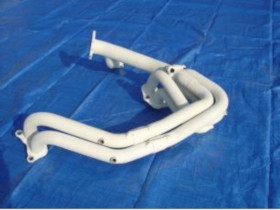
There is an alternative darker plasma ceramic coating, which contains alumina / titania and has a grey coloured appearance. This offers similar reductions in surface temperature, although the radiation of heat is slightly greater than with magnesia / zirconia. In all cases, except maybe some extreme situations, this coating gives the performance advantage but is less prone to aesthetic degradation due to its darker colour. This means the coating stays fresh and smart looking, which may be important for concourse cars.
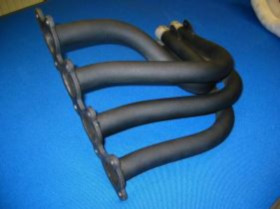
The well known white exhaust coatings became very popular in the 1990’s and are applied on many new breed turbo charged four wheel drive world rally cars. The proof of their success is demonstrated by the teams who opted for these coatings, which include key players in the industry such as Subaru and Mitsubishi.
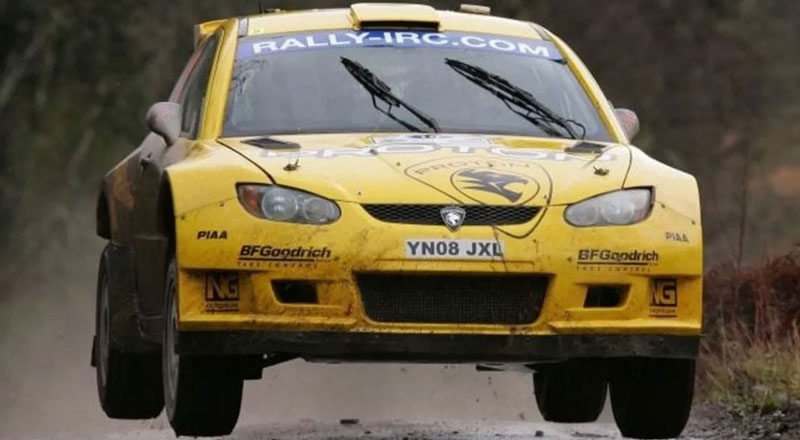
These days the use of ceramic coatings has become widespread including Touring Cars, Super Car manufacturers and various rallying disciplines, which have led through to private owners using the coatings on track day cars and fast road cars. Woof Thermal Management Technology currently supplies Mellors Elliot Motor sport and the works Proton S2000 Team.
John Holdsworth, Managing Director at Woof Thermal Management Technology, says: “It’s a really exciting time for Woof and we are thrilled to be expanding our services within the motor sport industry. To support our commitment to the industry we have decided to sponsor the Lancashire & Districts Subaru owners’ club ‘Best in Show’ trophy at the prestigious Preston Flag Market car show in April. This lets us get close to the car owners and provides great networking opportunities.”
Crucible Vessels
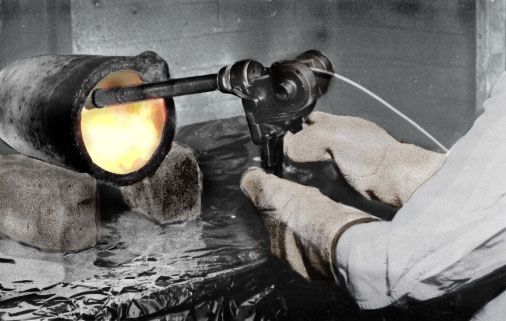
Research into the characteristics of metals carried out by the Fulmer Research Institute has involved the use of Salamander crucible vessels for melting high purity alloys at temperatures up to 2000oC. Due to the very high temperature the normal life of the vessels has been approximately 25 melting’s. The life of these crucibles has now been doubled following Flame spray treatment carried out by the Institute’s own metal spraying section, using a Metallisation Flame spray pistol fitted with an extension nozzle. The Research Institute use flame spraying in many of their research projects and it was therefore a simple matter to use the equipment to carry out the treatment to the salamander crucibles. The inner surface of each of the vessels has been given a ceramic deposit of 0.25mm (0.010”) alumina. In addition to prolonging the life of the crucibles, the ceramic deposit has also cut out the silicon pick-up from the inner surface of the vessel and this has resulted in the alloys obtained being of the highest purity.
Crucible and Sprue
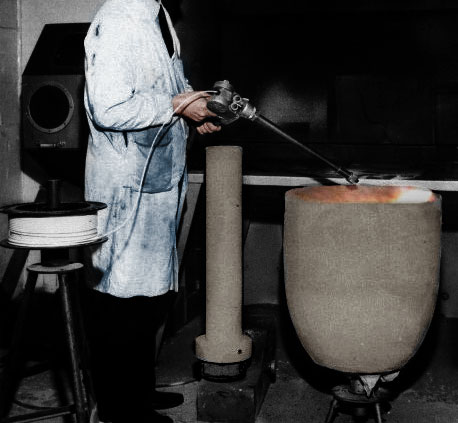
A crucible and sprue being sprayed with a protective coating to withstand corrosion and erosion caused by molten aluminium. The treatment consists of lightly grit-blasting the surface followed by the application of 0.1mm (0.004”) of aluminium and then 0.25mm (0.010”) of alumina. A Metallisation Flame spray pistol fitted with an extension nozzle and a deflector air nipple is shown spraying the alumina.
For more information on Metal Spray equipment or consumables, call us on 07 3823 1004, or email us using our contact form.